The tool moment
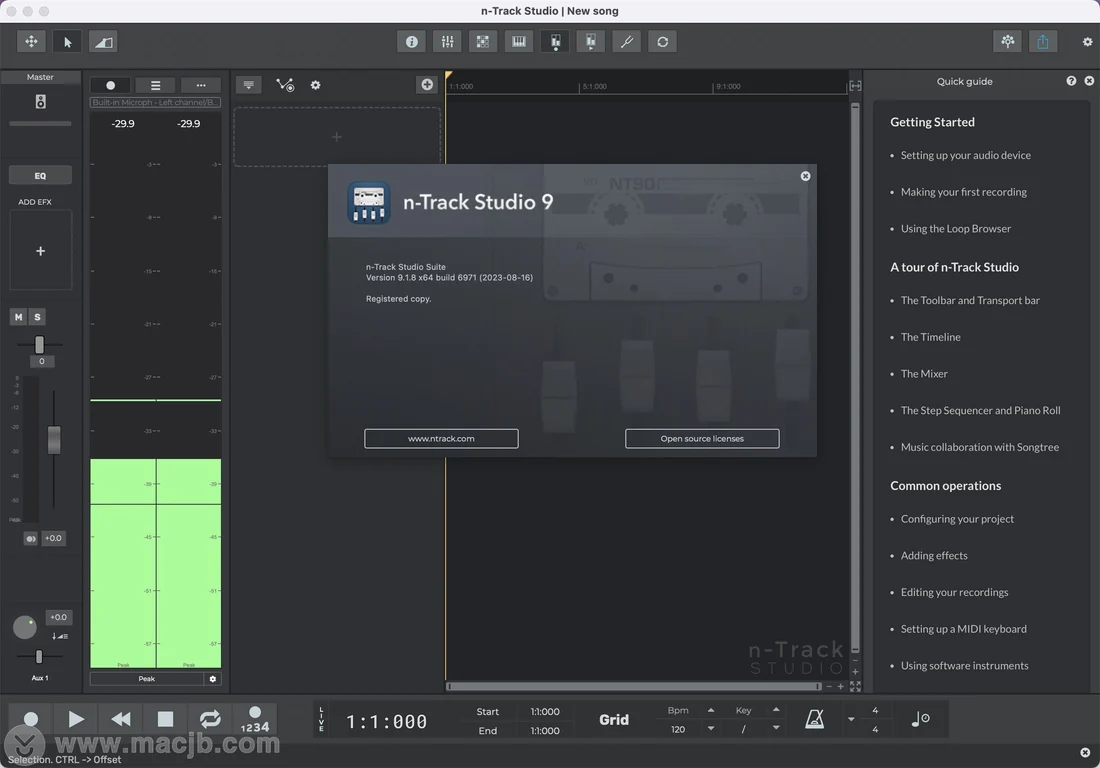
By n-Track Software's own account, its DAW began in 1995, when founder Flavio Antonioli could not afford a four-track tape multitrack recorder and decided to write his own instead. According to the company's company history page, he first tried it on Linux, trying to make a synchronized recording mode, then reluctantly tried doing the same thing on Windows 95 and succeeded in a matter of hours, because Windows' audio APIs were, at the time, much more advanced and stable than on Linux. The company's own press materials call the result one of the first commercial multitrack audio recording applications, released for personal computers when, in the company's words, almost nobody thought of recording multitrack audio on their personal computer.
What the documents show
Both pages are n-Track's own current company materials — an about page and a press question-and-answer sheet — not a contemporaneous 1995 record, so they are the company's retrospective account of its own origin rather than independently verified history. Notably, n-Track's own site currently displays a 30th-anniversary marker in its navigation, which, measured from the 2026 access date, implies a 1996 founding — one year later than the 1995 the same site's own history page and timeline state explicitly. That is a small inconsistency inside the company's own materials, worth naming rather than resolving by guesswork.
What stays with the musician
n-Track's own account frames the software as solving an access problem, not a creative one: the founder built it to record his own guitar playing when he could not afford the tape hardware to do it any other way. The company's current framing still centers the software as infrastructure for a musician's own performance and arrangement choices across desktop and mobile platforms, not a system that makes those choices for them.
Judge it by listening
n-Track's own materials make no claim about sound quality or a listening test for the 1995 release, so there is nothing to verify by ear from these documents. A reader assessing an affordable or first-of-its-kind claim can instead check the documented, non-sonic facts — platform choice, Windows 95, for the reasons the company itself gives, and the founder's stated reason for building it — rather than any audio-quality assertion, since these sources make none.
- Is n-Track's founding year being stated as 1995, per its own history page, or 1996, per its own anniversary marker?
- Does an affordable claim about early DAW software rest on a documented price comparison, or only on the software existing at all?
- Is a platform choice, like Windows over Linux in 1995, explained by the company's own stated reason, or assumed for other reasons?
A small, self-funded origin story like n-Track's is easy to round off into a clean anniversary date. The company's own materials do that too, in two slightly different ways, which is itself a useful reminder that even a company's own history page is a living document, not a fixed record.
Sources & reading trail
n-Track's own company history page states the first version was built in 1995 after the founder could not afford tape recording hardware, and lists a timeline entry for n-Track 1.0 in 1995.
Source published: Not established · Retrieved: 16 September 2026
n-Track's own press question-and-answer sheet repeats the 1995 founding story and describes the result as one of the first commercial multitrack recording applications for personal computers.
Source published: Not established · Retrieved: 16 September 2026
Documentation, papers and the makers' own records establish the note; the judgment about what stays with the musician is Mix & Meaning editorial analysis. This retrospective draft does not imply the site published on the event date.