The tool moment
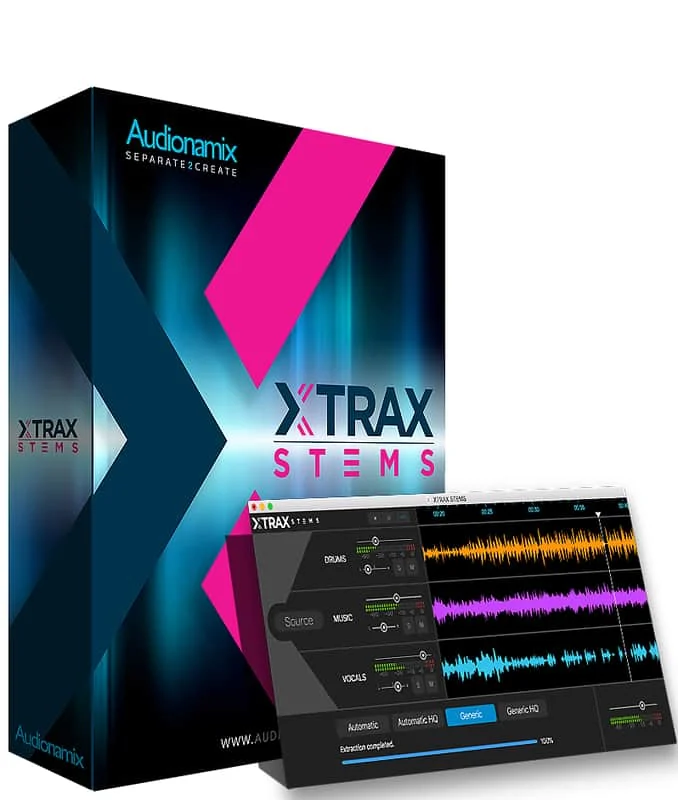
In December 2017, Audionamix released XTRAX STEMS, described on its own product page as "the world's first fully-automatic stem creator." Audionamix was not a new entrant: an archived company homepage from earlier that year shows its existing ADX TRAX and TRAX Pro line, built for isolating a single melodic or vocal line from a mix for film and post-production work. XTRAX STEMS repackaged that source-separation research for DJs and producers: the original product page, preserved on the Internet Archive since the live domain now redirects elsewhere, describes a tool that takes "one song in" and returns "three stems out," Vocal, Drums, and the remaining Music.
What the documents show
That 2017 page states the tool was "created for DJs, music producers and remix artists" to "create multitrack content to control during live sets," and separately for musicians "to practice along with their favorite tracks" by muting a vocal or drum part. A later archived version of the same product shows the stem count grew to four, Vocals, Drums, Bass, and remaining music, with selectable separation modes added along the way. Both pages are Audionamix's own marketing copy; neither publishes an independent accuracy figure, and testimonials quoted on the page are customer statements, not measured results.
What stays with the musician
Audionamix's own framing draws a line between two uses the tool itself does not distinguish: creating "multitrack content" for a remix or mash-up, and using isolated parts to practice alongside a recording. Both draw on the same stems, but a remix built from XTRAX STEMS output still depends on a producer's arrangement choices, how the extracted vocal is treated, pitched, or placed against new material, and on whatever rights clearance a remix or public performance actually requires, a question this tool's documentation does not address.
Judge it by listening
Because Audionamix's pages offer no listening-test data, judging XTRAX STEMS means listening to its outputs against the source track. This is an editorial suggestion: solo the "remaining music" stem, the hardest category for any separator since it is defined by exclusion, and listen for artifacts where vocal or drum transients were not cleanly removed. Compare the three-stem and four-stem eras if older exports are available, since splitting bass out of "remaining music" changes what bleeds into each part.
- Does the "remaining music" stem carry audible vocal or drum artifacts on your source track?
- Would a three-stem or four-stem split serve your remix idea better, and does the tool let you choose?
- What rights question does turning this separated audio into a released remix actually raise?
XTRAX STEMS mattered less for a single accuracy number than for moving Audionamix's post-production separation research into a subscription tool aimed at working DJs and producers; its own archived pages document that shift in audience and stem count, but not the sound quality a musician still has to judge for themselves.
Sources & reading trail
Archived original product page stating Audionamix is officially releasing XTRAX STEMS as a three-stem (Vocal, Drums, Music) automatic stem creator for DJs, producers and remix artists.
Source published: Not established · Retrieved: 16 September 2026
Shows the later four-stem version, Vocals, Drums, Bass, remaining music, with selectable separation options, documenting how the product changed after its 2017 launch.
Source published: Not established · Retrieved: 16 September 2026
Shows Audionamix's product line just before XTRAX STEMS existed, ADX TRAX, TRAX Pro and TRAX SP for melody and dialogue separation, establishing the company's separation research background.
Source published: Not established · Retrieved: 16 September 2026
Documentation, papers and the makers' own records establish the note; the judgment about what stays with the musician is Mix & Meaning editorial analysis. This retrospective draft does not imply the site published on the event date.