The tool moment
On 8 September 2019, the Journal of Open Source Software published "Open-Unmix, A Reference Implementation for Music Source Separation", by Fabian-Robert Stoter, Stefan Uhlich, Antoine Liutkus and Yuki Mitsufuji. Unlike the commercial separators built into DJ software or repair suites, Open-Unmix shipped as open training and evaluation code alongside a peer-reviewed paper, giving researchers, students and toolmakers a documented, reproducible baseline rather than a closed product. Its accompanying GitHub repository provides ready-to-use models plus the code needed to retrain or audit them.
What the documents show
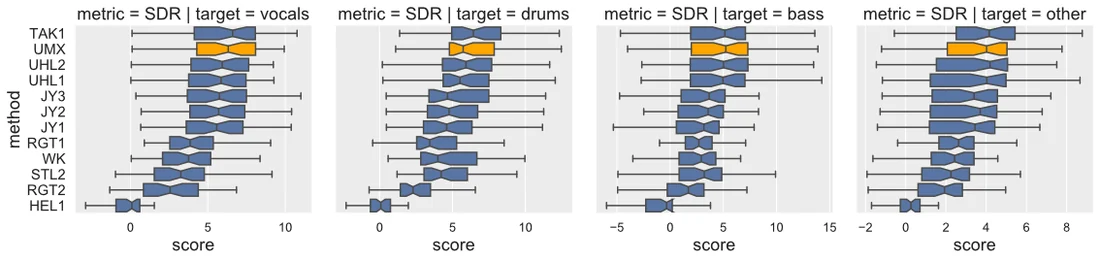
The project's own documentation states Open-Unmix separates a mix into four sources, vocals, drums, bass and a remaining "other" category, using a three-layer bidirectional LSTM network trained separately for each target. The repository reports median signal-to-distortion ratio scores for its larger model of roughly 7.2 for vocals, 7.2 for drums, 6.0 for bass and 4.9 for other, and states these results are competitive with entrants in the 2018 Signal Separation Evaluation Campaign. That is a documented, numeric benchmark, unlike most vendor pages in this field, but it remains the project's own reported figures rather than a comparison independently re-run by a third party, and JOSS review is lightweight, focused on the software itself rather than exhaustive replication of results.
What stays with the musician
Open-Unmix was built as a reference baseline, not a finished creative tool, so a musician who wants to use it directly still has to run the code, choose a model, and decide what an acceptable separation looks like for their own material; there is no vendor support line or preset library behind it. Because the code and weights are open, a producer or a toolmaker can also inspect exactly how the model handles a given source category, a transparency that closed commercial separators in this batch generally do not offer.
Judge it by listening
The reported SDR figures are a documented evaluation method, not a substitute for hearing the result on your own material: SDR summarizes distortion across a whole test set and will not flag every audible artifact on an individual track. This is an editorial suggestion: run Open-Unmix on a track outside the MUSDB18 evaluation set it was benchmarked against, and listen specifically to the "other" stem, the lowest-scoring of the four categories in its own reported numbers, for the artifacts a summary metric can hide.
- Does the "other" stem, the model's weakest category by its own reported score, hold up on your track?
- How does a model trained on the MUSDB18 dataset perform on material stylistically different from it?
- Would inspecting the open training code change how much you trust a closed commercial separator's claims?
Open-Unmix's contribution was giving the field a shared, inspectable baseline with published numbers attached; the tools built for DJs and editors elsewhere in this batch rarely offer either, which is exactly why a documented reference point like this one matters even without a retail interface.
Sources & reading trail
Peer-reviewed Journal of Open Source Software paper naming the authors and confirming Open-Unmix's publication as a reference implementation for music source separation.
Source published: 8 September 2019 · Retrieved: 16 September 2026
States the model is a three-layer bidirectional LSTM trained separately for four targets (vocals, drums, bass, other) and reports median SDR scores against the SiSEC 2018 benchmark.
Source published: Not established · Retrieved: 16 September 2026
Documentation, papers and the makers' own records establish the note; the judgment about what stays with the musician is Mix & Meaning editorial analysis. This retrospective draft does not imply the site published on the event date.