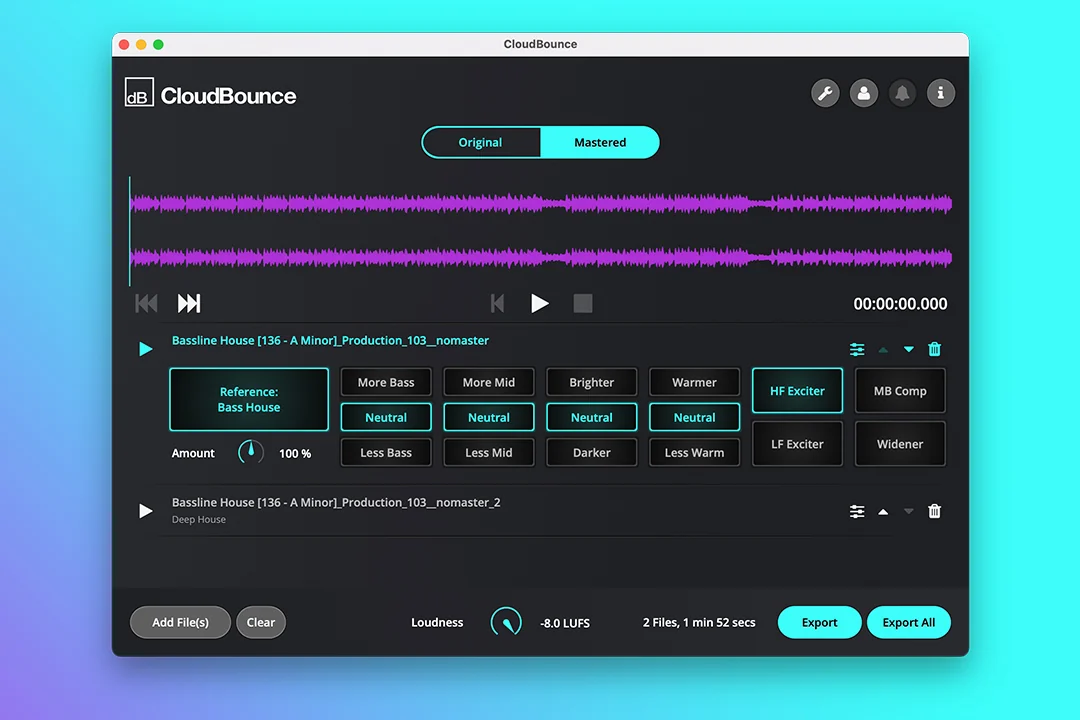
The tool moment
CloudBounce was a Finnish company offering automated online mastering: a musician uploaded a mix and received a processed master back without a human mastering engineer in the loop. An archived snapshot of the company's homepage, captured in January 2016, still describes the service as 'just around the corner,' inviting early sign-ups at $5.00 per track, with a copyright line reading 2015. That places the company's founding in 2015 and its public opening in 2016, situating it in the same early wave of browser-based automated mastering as LANDR, ahead of later entrants such as eMastered.
What the documents show
CloudBounce's own about page, archived in 2019, states the founders wanted to build 'an instant cloud-based mastering platform that takes advantage of modern audio technology and artificial intelligence.' That is the company's characterization of its own processing, not an independently verified description of the underlying method, and the same page is candid about a limit: it says 'automatic processing can never replace the final touch of a professional mastering sound engineer,' immediately followed by the claim that CloudBounce gets a user 'almost there.' No technical paper or third-party evaluation of the algorithm is cited on either archived page. The company's live site no longer resolves as of this writing, so this record depends entirely on the Internet Archive's copies of pages CloudBounce itself published.
What stays with the musician
An automated master is produced from whatever mix file is uploaded; it cannot ask a musician whether a loud snare was a deliberate choice or a mixing error, and it cannot renegotiate an arrangement decision the way a mastering engineer's feedback call sometimes does. Choosing reference tracks, deciding whether a rough mix even deserves mastering yet, and judging whether the returned file matches the record's intended tone all remain the musician's job. The 2019 about page's own hedge, that automation gets a user only 'almost there,' is the company's own boundary marker for what its process does not finish.
Judge it by listening
Because CloudBounce published no listening-test methodology, any evaluation here is editorial: compare the returned master against the original mix on the same playback system, checking specifically whether added loudness introduced new harshness or masking rather than simply raising the average level. A second useful check is running the same mix through more than one automated service, since a result that looks correct against one algorithm's target curve may not match what the artist intended for the record.
- Does the master's added loudness change how the mix's balance actually sits, or just how loud it reads?
- What reference, if any, did the service compare the track against?
- Would a second pass, or a different automated service, produce a materially different result?
CloudBounce's own archived pages describe a tool for getting a mix close to mastered quickly and cheaply, not a replacement for the judgment a mastering engineer brings to a specific record. That the company's public site is now gone is itself a reminder that a vendor's live documentation is not a permanent record.
Sources & reading trail
Archived pre-launch homepage showing the 2015 copyright, imminent-launch messaging, and $5-per-track pricing.
Source published: Not established · Retrieved: 16 September 2026
Company's own description of its AI-based mastering approach, its Finnish/UK team, and its own stated limits.
Source published: Not established · Retrieved: 16 September 2026
Documentation, papers and the makers' own records establish the note; the judgment about what stays with the musician is Mix & Meaning editorial analysis. This retrospective draft does not imply the site published on the event date.