The tool moment
Waves Audio released Vocal Rider on 16 November 2009, describing it in its own press release as 'the first of Waves' pioneering series of innovative new Mixing tools.' The plug-in automated a task every mixing engineer already knew: riding a vocal fader up and down through a song so the voice stays present without a compressor's coloring. Before Vocal Rider, that ride was drawn by hand on an automation lane or performed live on a physical fader. The release positions the tool squarely at the mixing stage, not mastering or generation, and predates by several years the machine-learning-branded mixing assistants later vendors would build.
What the documents show
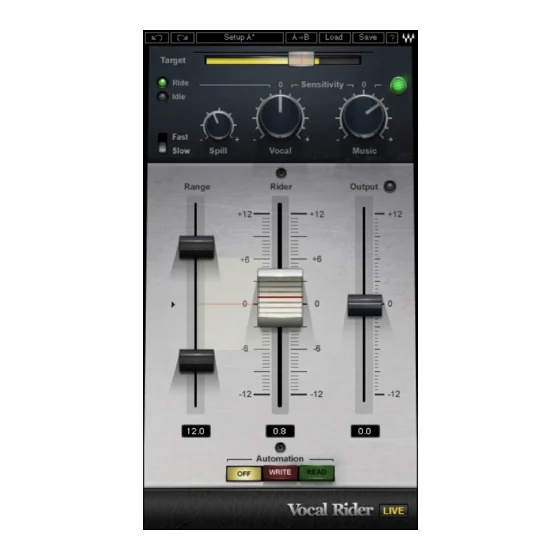
The release states the method plainly: a user sets 'the target range of the vocal level in relation to the rest of the mix,' and the plug-in 'compensates for all deviations from the target, intelligently raising or lowering the vocal volume, instantly.' A 2013 archive of the product's own page repeats much of the same description years later, adding that Vocal Rider adds 'absolutely no additional coloring to the track,' distinguishing gain riding from compression. Waves' documentation lists controls, Vocal Sensitivity, Music Sensitivity, Range Min/Max, and Attack, that describe a rules-based leveling algorithm reacting to signal level against a set target. Neither document uses the language of machine learning or artificial intelligence; the word 'intelligently' describes the outcome, not the method, and should not be read as an AI claim.
What stays with the musician
Vocal Rider needs a target range before it does anything, and setting that range, how present the vocal should sit against the instrumental at a given point, is an arrangement decision the plug-in does not make. The documentation notes the automatic ride can be written to an automation track for fine-tuning afterward, meaning Waves itself expects a mixer to revise the result rather than accept it outright. A vocal that should recede for effect in a bridge, or push forward loud for a moment of drama, is a choice Vocal Rider will flatten toward the target unless the mixer overrides it.
Judge it by listening
Because the tool's own claim is about consistency, not tone, a useful check, editorial rather than Waves-published, is whether the leveled vocal still breathes with the song's dynamics or has been ironed into a flat presence. Listen to a verse-to-chorus transition with Vocal Rider bypassed, then engaged, and judge whether the automatic ride preserved or erased the performance's natural lift.
- Did the target range match how present the vocal needs to be at each section, or one setting for the whole song?
- Does the leveled vocal still carry the performance's dynamic contrast, or has it flattened?
- Would manual automation, redone after Vocal Rider's pass, better serve what the musician actually wants?
Vocal Rider's own documentation, from 2009 to its current product page, describes a real-time leveling tool built to save the time a manual fader ride takes, a narrower and older claim than the AI-branded mixing assistants that arrived years later, and one worth naming correctly.
Sources & reading trail
Waves' own press release giving the release date and describing the target-range, rules-based leveling method.
Source published: 16 November 2009 · Retrieved: 16 September 2026
Product page repeating and extending the method description, including the no-added-coloring claim.
Source published: Not established · Retrieved: 16 September 2026
Documentation, papers and the makers' own records establish the note; the judgment about what stays with the musician is Mix & Meaning editorial analysis. This retrospective draft does not imply the site published on the event date.