The tool moment
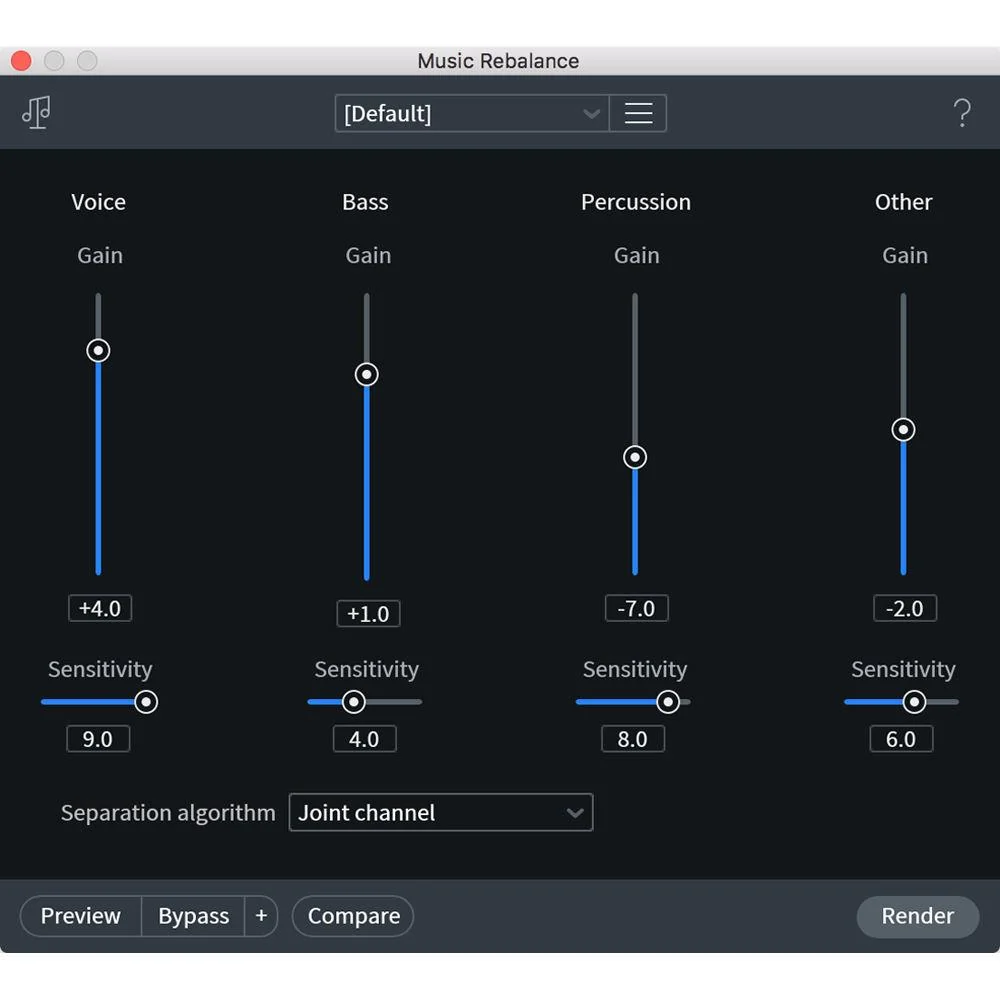
In September 2018, iZotope shipped RX 7 with Music Rebalance, a source-separation module built into its RX audio-repair suite. Unlike a DJ tool built for on-the-fly remixing, Music Rebalance was designed to work inside a finished stereo file: an editor loads a mix that was never delivered as stems and asks the software to estimate what belongs to the vocal, the bass, the percussion, and everything else. The RX 7 product page lists Music Rebalance alongside Repair Assistant as the version's two headline additions, and iZotope's companion tutorial for the feature is dated to that same September.
What the documents show
iZotope's own technical explainer, published 25 September 2018, states that Music Rebalance runs the input through multiple neural networks, each trained to recognize one source, then combines their outputs to estimate how much of each source is present at every time and frequency. The result is four adjustable elements, vocals, bass, percussion, and a remainder iZotope calls "other," each independently controllable in gain relative to the original mix. This is iZotope's own account of its method, not an independently verified benchmark, and the company frames the underlying networks as an estimate rather than a perfect decomposition.
What stays with the musician
iZotope's how-to guide is explicit that Music Rebalance serves two different jobs: an editor can isolate a vocal from a pop song to place it in a new arrangement for a remix, or attenuate a sung vocal to clear a path for dialogue in post-production. iZotope's documentation does not privilege one use over the other, which matters because it means the tool does not decide whether a rebalanced element is fit for creative reuse or only for masking a problem; a musician has to judge how much of the original performance's character survives the rebalance before building a new arrangement on top of it.
Judge it by listening
Because iZotope publishes a method rather than a listening-test score, evaluating Music Rebalance means applying that method by ear. This is an editorial suggestion: push a single element, the vocal, to its extreme isolated setting and listen against the same section soloed from any true multitrack you may have access to, noting where percussion or harmonic content leaks through. Repeat at a moderate rebalance setting, the range iZotope's dialogue use case actually depends on, since a partial rebalance is usually less artifact-prone than a full isolation.
- Does the isolated vocal retain enough of its original character to sit in a new arrangement?
- What bleeds through from the other three elements at full isolation versus a moderate rebalance?
- Would the source material have been better served by dialogue-style attenuation than full extraction?
Music Rebalance's real contribution is turning a finished stereo file into four negotiable parts; iZotope's documents describe the estimate, but only a listening pass tells a musician whether that estimate is good enough to build on.
Sources & reading trail
States that Music Rebalance uses trained neural networks to output four elements, vocals, bass, percussion and a remainder called other, and describes the adaptive-filtering method.
Source published: 25 September 2018 · Retrieved: 16 September 2026
Describes Music Rebalance's two documented uses, isolating a vocal for a remix and attenuating vocals to clear dialogue, directly from iZotope.
Source published: Not established · Retrieved: 16 September 2026
Archived iZotope product page stating RX 7 introduced Repair Assistant and Music Rebalance, dating the companion tutorial to 13 September 2018.
Source published: Not established · Retrieved: 16 September 2026
Documentation, papers and the makers' own records establish the note; the judgment about what stays with the musician is Mix & Meaning editorial analysis. This retrospective draft does not imply the site published on the event date.