The tool moment
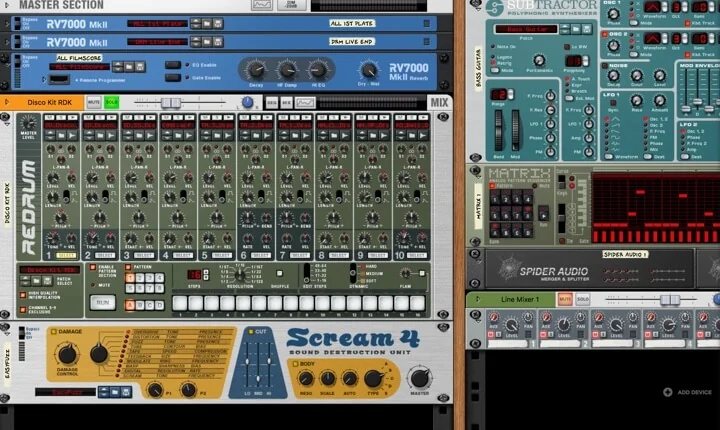
Propellerhead's own company timeline, now maintained by Reason Studios, dates Reason's release to 2000: with its virtual cable and modular approach to music making, Reason brought a complete studio of hardware synths, effects and devices into any musician's reach, creating a new category of software the timeline calls the instrument host application. The same timeline traces the company's earlier products — 1994's ReCycle, which sliced samples into rearrangeable loops, and 1997's ReBirth, which put software versions of the Roland TB-303 and TR-808 on a computer — as the lineage Reason grew from: virtual recreations of hardware, connected inside the computer instead of by physical cables.
What the documents show
Reason Studios' own timeline draws a clear boundary: Reason in 2000 hosted virtual instruments and effects patched together on a virtual rack, and audio recording did not arrive until a separate product, Record, in 2009, which the timeline says introduced audio recording and editing with a large-format mixing console. The company's current product page still describes Reason as 'the Rack and the devices,' with modular CV and audio routing on the back of the Rack, tracing to the 2000 design. The timeline's 2012 entry states Rack Extensions let outside developers add to what had, until then, been a fixed set of Propellerhead-built devices.
What stays with the musician
A fixed, non-expandable rack of devices — Reason's original design, before 2012's Rack Extensions — could not be padded out with an endless plugin marketplace the way a VST-hosting DAW could. That pushed a different decision onto the musician: working within a known, closed set of synths and effects, learning what each did well, rather than searching an open marketplace for a plugin that might solve a problem. Neither source claims this made better records; it describes a design choice that traded expandability for a bounded, knowable toolset, and it was always the musician's job to decide whether that trade suited a session.
Judge it by listening
Because the sourced material is specific about what changed and when — instruments in 2000, audio recording only in 2009, third-party expansion only in 2012 — a listener can date what was technically possible when a track was made, rather than assuming a modern feature set applied retroactively. A track made in Reason before 2009 could not have recorded audio inside the program itself, which narrows what a listener should expect from that workflow. Judging the software's 'complete studio' claim by ear means checking whether a track's instrumentation could plausibly have come from Reason's own bounded rack, not a later version's expanded toolset.
- Could this specific Reason-era track have used audio recording, given when the session was actually made?
- Is an instrument sound coming from Reason's original built-in rack, or from a later Rack Extension?
- Does 'modular' here mean a fixed set of virtually cabled devices, or an open-ended plugin marketplace?
Reason Studios' own timeline is candid about the order these features arrived in, making it a reasonably reliable guide to what a given version could and could not do, even if the promotional language around each launch is the company's own.
Sources & reading trail
Reason Studios' own timeline dates Reason's 2000 release, its virtual-cable/modular rack approach, and states audio recording was only added later, with Record in 2009.
Source published: Not established · Retrieved: 16 September 2026
Describes Reason today as 'the Rack and the devices' with modular CV and audio routing, the same conceptual design as the original.
Source published: Not established · Retrieved: 16 September 2026
Documentation, papers and the makers' own records establish the note; the judgment about what stays with the musician is Mix & Meaning editorial analysis. This retrospective draft does not imply the site published on the event date.