The tool moment
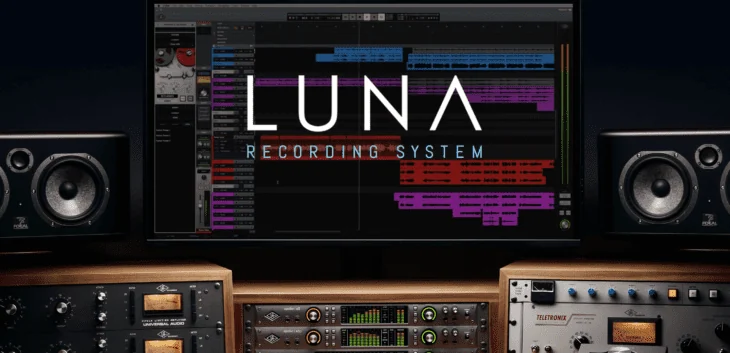
Universal Audio's own Luna Recording System page, in the earliest form located in the Wayback Machine, was already offering the software “FREE for all existing Thunderbolt Apollo & Arrow interfaces (Mac only)” when archived in April 2020. The page describes Luna Extensions as effects “built into the fabric of LUNA's mixer” rather than loaded as plugins: a Neve Summing extension recreating “analog summing from the famed Neve 80 series consoles,” and a Studer Analog Tape extension modeled on the Studer A800 recorder, adjustable with “per-track Saturation controls” and master settings for “Tape Formula, Tape Speed (IPS), and more.” Its footnote is explicit about the hardware dependency: “LUNA requires a Thunderbolt Apollo or Arrow connected to a Thunderbolt Mac.”
What the documents show
This is Universal Audio's own marketing, not an independent workflow study, and the terms it states held for well over a year: an August 2021 capture still promised the software “FREE for all existing Thunderbolt Apollo & Arrow interfaces (Mac only)” and repeated that “LUNA requires a Thunderbolt Apollo connected to a Thunderbolt Mac.” Universal Audio's current Luna page, retrieved 16 September 2026, states something different: “LUNA needs no UA hardware. It runs natively on your Mac or Windows computer and works with any audio interface.” Read together, the documents show a hardware-tied free tier at launch that later became interface-agnostic; treating today's living page as evidence of the original terms would misdate the fact this entry is trying to pin down.
What stays with the musician
Built-in console and tape emulation changes where the analog character comes from, not whether a session needs any. A Neve-modeled summing bus or Studer-modeled tape stage colors a mix only as much as a musician chooses to drive it – the Saturation control and Tape Speed setting are creative decisions, not defaults that produce a finished sound alone. Deciding whether a track needs that coloration, or whether it fights the source material, is still made by ear, session by session.
Judge it by listening
Universal Audio's pages describe what the extensions model, not how convincingly, so comparing in-the-box processing against Luna's built-in analog path is an ear-led test the vendor's copy does not settle. This is editorial guidance beyond the source: bounce the same rough mix through Luna's Neve Summing and Studer Tape extensions and against a plugin-based alternative, then listen for how each handles transient peaks and low-end buildup, since that is where emulated analog behavior is easiest to hear and easiest to overdo.
- Would this track still need Luna's tape saturation if the arrangement were less dense?
- Is the free tier's original Apollo-only requirement still the deciding factor, or does the newer no-hardware policy change that?
- Does the Neve-modeled summing change the mix's balance decisions, or just its color?
Luna's free-with-hardware model was a bet that an interface maker could win a recording workflow by building the analog chain into the DAW; Universal Audio's own pages show that bet in place by 2020 and its terms loosening years later, a distinction worth keeping straight before crediting either moment to the wrong year.
Sources & reading trail
Earliest located capture of UA's own Luna page, already offering it free for Thunderbolt Apollo and Arrow owners and describing Neve summing and Studer tape as extensions built into the mixer, by April 2020.
Source published: Not established · Retrieved: 16 September 2026
2021 capture confirming the same free-for-Apollo, Mac-only, Thunderbolt-required terms remained unchanged over a year later.
Source published: Not established · Retrieved: 16 September 2026
Current living page stating LUNA now runs on Windows too and needs no UA hardware, a looser requirement than the original Apollo-only terms.
Source published: Not established · Retrieved: 16 September 2026
Documentation, papers and the makers' own records establish the note; the judgment about what stays with the musician is Mix & Meaning editorial analysis. This retrospective draft does not imply the site published on the event date.