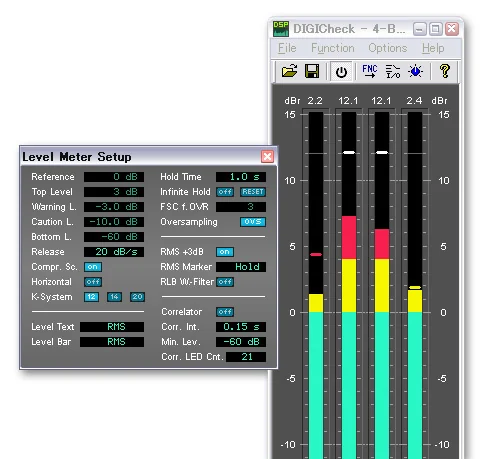
The tool moment
Mastering engineer Bob Katz built the K-System as a metering and monitoring scale meant to fix a specific, recurring problem: a mix or master judged correctly in one room, at one volume, can sound wrong somewhere else, partly because monitoring levels are rarely held constant from session to session. Katz's own site describes three linked meters in its account of the system. K-20 sets 0 dB at -20 dBFS with an 83 dB SPL monitor calibration, intended for wide-dynamic-range material such as classical or audiophile mixes; K-14 sets 0 dB at -14 dBFS for the moderately compressed pop, folk, and rock material most home listeners encounter; and K-12 sets 0 dB at -12 dBFS for material destined for broadcast.
What the documents show
Katz's own published description states the unifying idea directly: 0 dB is meant to represent the same calibrated monitoring loudness across all three scales, so an engineer moving between K-20, K-14, and K-12 material keeps a consistent listening reference rather than resetting their ears each time. A more recent FAQ page on Katz's site shows the system is not frozen: in the third edition of his book Mastering Audio, Katz revised the K-System to use LUFS-based loudness measurement, keeping the same relative 0 LU scale but tying it to -12, -14, or -20 LUFS rather than dBFS peak levels. As a method still maintained and revised by its author, this description reflects Katz's own site as retrieved on 16 September 2026; the K-System's original publication date could not be confirmed from the pages available.
What stays with the musician
The K-System addresses monitoring consistency, not taste. It does not tell a musician which K-scale headroom suits their genre beyond Katz's own general guidance, nor does it replace the judgment of whether a mix actually sounds right; it only removes one variable, an uncalibrated playback level, that can make an otherwise sound decision seem wrong in a different room.
Judge it by listening
Editorially, a reader can check whether their own monitoring level is closer to a K-20, K-14, or K-12 reference by playing calibrated pink noise and comparing the SPL Katz's documentation describes, rather than trusting whatever volume the monitor knob happened to be at.
- Is a mix being judged at a level that would change which details are audible?
- Would the same mixing decision survive a switch from a K-20 to a K-12 headroom target?
- Is a loudness complaint really about the master, or about an uncalibrated playback level?
The tool a listening decision needs most is sometimes not a plugin at all. Katz's system is a reminder that the monitoring chain itself is part of what a musician has to control before judging anything downstream of it.
Sources & reading trail
States the K-20/K-14/K-12 reference points, their dBFS calibration and 83 dB SPL monitoring target, and the rationale for the system.
Source published: Not established · Retrieved: 16 September 2026
Confirms Katz revised the K-System to LUFS-based measurement in the third edition of Mastering Audio, and gives a practical calibration example.
Source published: Not established · Retrieved: 16 September 2026
Documentation, papers and the makers' own records establish the note; the judgment about what stays with the musician is Mix & Meaning editorial analysis. This retrospective draft does not imply the site published on the event date.