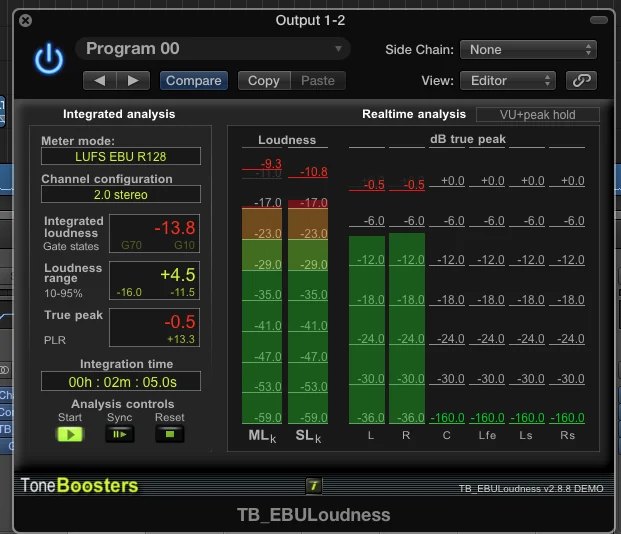
The tool moment
In August 2010, the European Broadcasting Union published the first version of Recommendation R128, according to the EBU's own loudness page, establishing a method for measuring and normalizing programme loudness using LUFS, loudness units relative to full scale, instead of the peak meters that had driven broadcast delivery until then. For a mastering engineer, R128 mattered less as a broadcast rule than as a shared reference point: it gave the concept of loudness a standardized measurement algorithm and a target number, rather than leaving it to a peak reading that said nothing about how loud a track was perceived to be next to another one.
What the documents show
The EBU's own materials specify a target of -23 LUFS with a tolerance the organization has revised over several versions; the recommendation's publication page records a version 3.0 tolerance of plus or minus 0.5 LU and a current version 5.0, dated 21 November 2023, that added guidance for cinematic content on top of the original broadcast scope. R128 is explicitly a living document: the EBU continues to issue supplementary specifications, referred to as R128 s1 through s4, alongside companion technical documents, EBU Tech 3341 for loudness metering and Tech 3342 for loudness range, rather than freezing the 2010 text in place. None of this is a music-industry mastering target by itself; R128 was written for broadcast delivery, and the document set does not claim to set the loudness a music streaming service applies on playback, which is a separate, platform-specific decision outside R128's own scope.
What stays with the musician
A measurement standard tells an engineer what number a meter will report; it does not decide how a record should feel next to a quiet passage or a deliberately harsh chorus. Mastering to a loudness target that a streaming platform applies on playback is a workflow decision layered on top of R128's measurement method, and conflating the two, treating a broadcast recommendation as if it were a specific platform's playback rule, is a documented category error worth avoiding when a brief cites LUFS without saying which target and which document it means.
Judge it by listening
Because R128 specifies a measurement, not a creative outcome, the relevant listening check, editorial since the EBU does not publish a music-mastering method, is comparing two masters normalized to the same LUFS figure but built with different amounts of dynamic-range compression, to hear that identical loudness numbers can still sound very differently loud in practice.
- Which version of R128, and which target number, is actually being referenced in a given brief or platform's documentation?
- Does a loudness-matched comparison still reveal an audible difference in perceived intensity between two masters?
- Is the loudness target being treated as a broadcast-delivery spec or, incorrectly, as this record's platform target?
R128 gave the industry a shared vocabulary and a measurable number for loudness; more than a decade and five revisions on, it remains a measurement standard for engineers to reference correctly, not a creative decision it makes on a musician's behalf.
Sources & reading trail
EBU's own page stating the August 2010 first publication of R128 and describing the -23 LUFS normalization method.
Source published: Not established · Retrieved: 16 September 2026
Publication page giving the version history, tolerance changes, current version 5.0 date, and related Tech 3341/3342 documents.
Source published: 21 November 2023 · Retrieved: 16 September 2026
Documentation, papers and the makers' own records establish the note; the judgment about what stays with the musician is Mix & Meaning editorial analysis. This retrospective draft does not imply the site published on the event date.