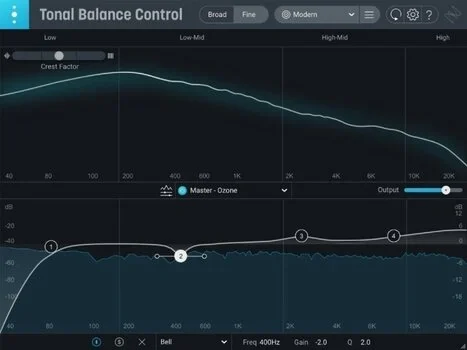
The tool moment
iZotope's Tonal Balance Control compares a mix's frequency balance against a genre-specific target curve, giving a mixing or mastering engineer a documented reference point beyond their own ears and room. The tool's exact original release date could not be confirmed from iZotope's own pages checked for this note, but an iZotope learn article dated 3 October 2019, published alongside that year's Ozone 9 update, already describes Tonal Balance Control as an established part of iZotope's mixing toolkit gaining "a resizable interface and expanded plugin compatibility," meaning the tool predates that update.
What the documents show
The 2019 article states that the genre target curves were built in-house at iZotope after "analyzing thousands of masters," and recommends inserting the plugin at the end of a mix or master bus chain, then selecting a target curve to compare against. iZotope's current product page, retrieved 16 September 2026 and now describing version 3, states the curve library has grown to more than thirty genre targets built from analyzing hundreds of professional masters, alongside a standalone desktop app for capturing custom targets directly from streaming audio. Both pages describe the tool the same way: as something a user compares their mix against and adjusts by ear or by hand, not something that edits a mix on its own. As a still-updated product line, now on its third version, this description reflects the pages as retrieved on 16 September 2026.
What stays with the musician
A reference curve built from professional masters describes where commercial releases in a genre statistically tend to sit; it does not describe where a specific song should sit. iZotope's own framing treats the tool as a guide, and the decision to match, depart from, or ignore a target curve for a given mix remains the mixing engineer's, informed by the arrangement and the artist's intent rather than dictated by an average of other people's masters.
Judge it by listening
Editorially, a mix that measures close to a genre target curve should still be checked by ear against the same reference tracks the curve was built from, since a visual match on a meter does not guarantee the two will sound alike on a given set of speakers.
- Does matching the target curve actually make the mix sound more like the reference genre, or just move a meter?
- Is the chosen genre target actually appropriate for this specific song's arrangement?
- Would a custom target built from a chosen reference track serve the song better than a broad genre average?
Tonal Balance Control gives a mixing engineer a documented comparison point instead of memory alone. What to do with that comparison, whether to close the gap or leave it open, is still a decision the tool leaves entirely to the musician.
Sources & reading trail
Dated (3 October 2019) iZotope article describing the tool's workflow, its in-house genre target curves, and the Ozone 9-era interface update, confirming the tool predates late 2019.
Source published: 3 October 2019 · Retrieved: 16 September 2026
Current (version 3) product page describing the expanded genre-target library, the standalone reference-capture app, and the tool's framing as a visual reference rather than an automatic processor.
Source published: Not established · Retrieved: 16 September 2026
Documentation, papers and the makers' own records establish the note; the judgment about what stays with the musician is Mix & Meaning editorial analysis. This retrospective draft does not imply the site published on the event date.