The tool moment
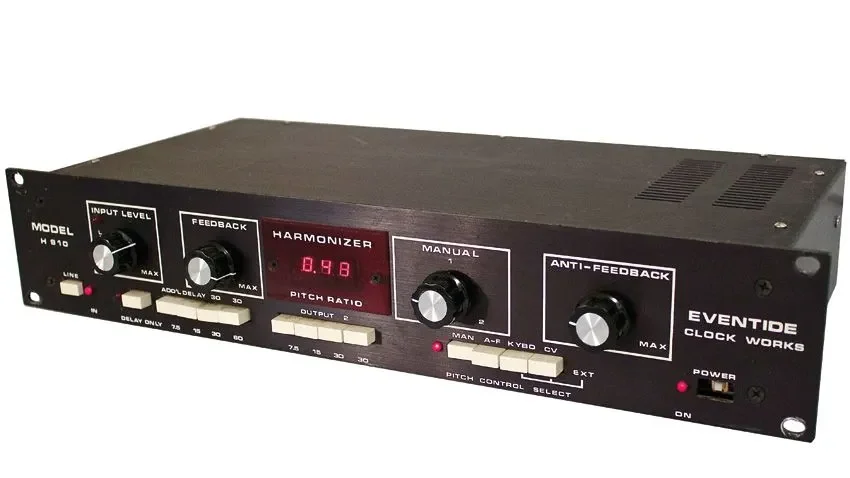
Eventide's own company timeline dates the H910 Harmonizer's commercial availability to 1975, following a 1974 concept by engineer Tony Agnello. The timeline states the H910 was the world's first commercially available digital audio effects device: it combined pitch change with delay and feedback and could be controlled by a remote keyboard to instantly shift pitch in half steps, with a two-octave range and up to 112.5 milliseconds of delay. For a working engineer, that meant pitch could be changed electronically, in real time, without slowing or speeding a tape machine.
What the documents show
Eventide's company history page credits the H910's development to Tony Agnello working in-house, and both pages describe it as the product that established the company commercially: the timeline calls it the first Eventide product to achieve almost instant, lucrative, and widespread popularity. The timeline names early adopters, including AC/DC and Frank Zappa, and states the unit's audible splicing artifact — 'the famous, audible glitch' — was embraced by artists like Laurie Anderson rather than treated only as a defect. These are the manufacturer's own historical claims about its customers, and should be read as company history rather than a documented usage log.
What stays with the musician
The H910 shifted pitch by the interval a musician selected and dialed in by hand or by remote keyboard; it did not detect a performer's intonation or correct it toward a target pitch, a function that would not exist in mass-market form for another two decades. Eventide's own timeline draws this line directly, noting that the later H949 (1979) added autocorrelation to reduce splicing artifacts and enabled real-time tuning 'long before Autotune' — language that only makes sense if the H910 itself did not perform automatic tuning. Every decision about how much pitch shift to apply remained the engineer's.
Judge it by listening
The audible seam Eventide's materials describe — a glitch produced by the splicing method used to delay and re-pitch audio — is a specific, describable artifact, not a vague claim of vintage character. A listener evaluating a modern plugin that claims to emulate the H910 can listen specifically for that splice behavior at extreme settings, where the original hardware's limitations were most audible, rather than judging the plugin only on how clean it sounds at moderate settings. Cleanliness was not what made the H910 distinctive; the audible trace of its method was. This framing is editorial, not a claim made in Eventide's own materials.
- Is a pitch-shift tool being asked to correct a performance, or to create an effect, and does its design match that job?
- At extreme settings, does an emulation reproduce the artifact that defined the original, or only its clean, moderate-setting behavior?
- Whose account of who used a piece of gear is this — the manufacturer's, the artist's, or an independent record?
Eventide's own history is the direct primary source for the H910's release date and design, and it is worth reading as a company's account of its own breakthrough product: informative about what the machine did, and unavoidably favorable about what it made possible.
Sources & reading trail
Eventide's own timeline dates the H910's 1975 commercial availability, its remote-keyboard pitch control, and named early users.
Source published: Not established · Retrieved: 16 September 2026
Company history describing Tony Agnello's development of the H910 in-house and its rapid commercial success.
Source published: Not established · Retrieved: 16 September 2026
Documentation, papers and the makers' own records establish the note; the judgment about what stays with the musician is Mix & Meaning editorial analysis. This retrospective draft does not imply the site published on the event date.