The tool moment
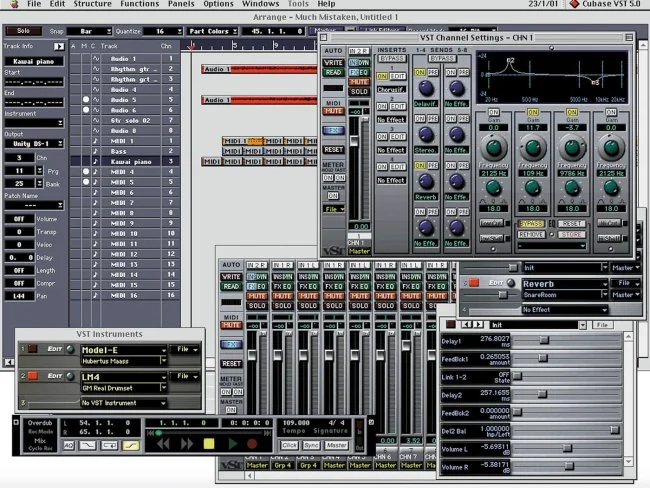
Steinberg's own company history page dates the breakthrough to 1996, when Virtual Studio Technology, or VST, was incorporated into Cubase, with Cubase VST becoming the first native software to incorporate a real-time studio environment including EQs, effects, mixing and automation. The same page states that, on an Apple Macintosh, the format let 24 audio tracks play simultaneously alongside an unlimited number of MIDI tracks — processing and virtual effects running inside the host, rather than through external hardware racks patched in over cables. That shift, from outboard gear to software inside the DAW, is the direct ancestor of every plugin-based mixing tool in use today.
What the documents show
Steinberg's separate technology page is explicit that VST was developed by Steinberg and first launched in 1996 as an open standard, and names companies that built for it: instrument creators are described as including Waldorf and Native Instruments, with Spectral Design and TL Audio credited for effect processors. That openness claim is Steinberg's own description of its licensing choice, but it is checkable: unlike a closed, single-vendor system, VST let outside developers build instruments and effects that ran inside any compatible host. Neither page claims VST was the first plugin format ever built, only the first to reach this milestone inside Cubase.
What stays with the musician
An open plugin format multiplies the tools available to a musician; it does not choose among them. Steinberg's own materials describe VST as infrastructure — a way for an instrument or effect to communicate with a host — and say nothing about which EQ curve or automation move actually serves a mix. The same openness that let Waldorf and Native Instruments build for VST also means a musician now filters a large catalog of third-party plugins, many making unverified quality claims, to find ones that suit a decision. The format solved a compatibility problem; it left the taste problem exactly where it was.
Judge it by listening
Because VST's stated achievement is running real-time effects and mixing inside the computer rather than through outboard hardware, a fair comparison is not 'plugin versus no processing' but a specific VST effect against the hardware unit it was built to replace, on the same source, at matched settings where the parameters allow it. Steinberg's pages document what the format made technically possible — simultaneous audio and MIDI tracks, real-time automation — not whether a given plugin sounds as good as the hardware it emulates; that judgment sits with the listener, and is not settled by the format's own history.
- Is this plugin doing something a hardware unit could not, or replacing one at a comparable cost and sound?
- How many of the plugins loaded in this session are actually shaping the mix, versus sitting unused?
- Does an 'open standard' claim describe how many companies build for a format, or how well those tools actually interoperate?
VST's 1996 debut inside Cubase is well documented by Steinberg's own materials, unsurprising for a format the company still develops; the plugin ecosystem it enabled is now large enough that no single source, including Steinberg's, describes all of it.
Sources & reading trail
Steinberg's own company history dates VST's 1996 debut inside Cubase VST, describing real-time EQ, effects, mixing and automation on 24 simultaneous audio tracks.
Source published: Not established · Retrieved: 16 September 2026
Describes VST as an open standard developed by Steinberg and first launched in 1996, naming third-party companies that built instruments and effects for it.
Source published: Not established · Retrieved: 16 September 2026
Documentation, papers and the makers' own records establish the note; the judgment about what stays with the musician is Mix & Meaning editorial analysis. This retrospective draft does not imply the site published on the event date.