The tool moment
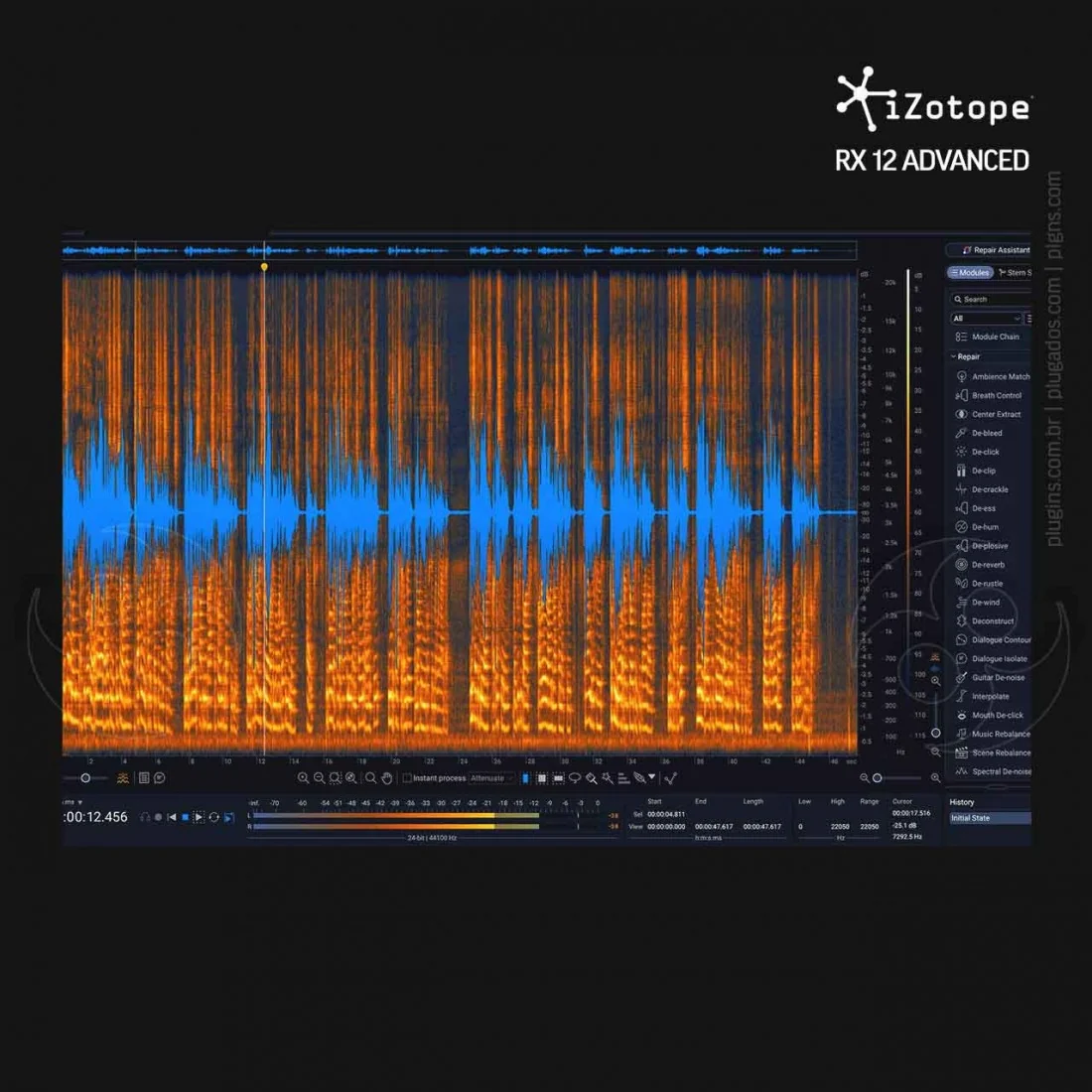
iZotope announced RX at an AES convention booth in New York on 5 October 2007, describing it in its own press release as a standalone application 'featuring the essential tools for cleaning and restoring audio.' The original RX combined a denoiser, a declipper, a declicker, hum removal, and a spectral-repair tool that could re-synthesize a damaged or missing section of audio, built around what the company called an advanced spectrogram display. For musicians and post-production engineers, RX moved audio repair out of scattered single-purpose plug-ins and into one dedicated application with a shared visual interface for finding and fixing problems.
What the documents show
The archived product page from the week of release lists the same module set as the press release, priced at $349 for RX and $1,199 for RX Advanced, with plug-in versions of the real-time modules promised for early 2008. Neither document mentions music-source separation; RX 1's Spectral Repair worked by re-synthesizing a damaged region of a single track, not by isolating one instrument from a finished mix, a capability iZotope would not add until much later versions such as Music Rebalance. The company's own quote from its CTO frames the release around cleaning up recordings from an expanding range of consumer sources, 'cell phones, video cameras, computers, old vinyl records, tape,' rather than any music-production or AI framing; RX 1 predates iZotope's later machine-learning marketing by close to a decade.
What stays with the musician
RX's tools work on a region a person selects and a setting a person chooses; Spectral Repair's re-synthesis, in particular, fills a gap based on the surrounding audio, so judging whether the result sounds plausible for that specific recording, a singer's vibrato, a room's natural decay, is left entirely to the engineer using it. The press release's own list of applications, from forensics to archiving, signals the tool is meant to be steered toward very different acceptable outcomes depending on the use, a judgment RX itself cannot make.
Judge it by listening
Because RX 1's own materials claim only the removal of specific classes of noise and damage, the relevant listening test, editorial rather than one iZotope specifies, is comparing the repaired section against the surrounding untouched audio for continuity: does a de-clicked passage still match the room tone and instrument timbre around it, or does the repair leave an audible seam.
- Does the repaired section sound continuous with the untouched audio around it?
- Was the tool used to solve a genuine defect, or to erase a texture that was part of the original performance?
- Would a lighter setting preserve more of the source while still fixing the problem?
RX's 2007 launch documents describe a repair tool for damaged or noisy audio, not a mixing or source-separation product; later iZotope tools inherited its interface ideas but not its original feature set, a distinction worth keeping when a modern RX version is discussed as if it always did everything the current one does.
Sources & reading trail
iZotope's own press release giving the AES 2007 announcement date, module list, and pricing.
Source published: 5 October 2007 · Retrieved: 16 September 2026
Contemporaneous product page confirming the module set and absence of any source-separation feature in RX 1.
Source published: Not established · Retrieved: 16 September 2026
Documentation, papers and the makers' own records establish the note; the judgment about what stays with the musician is Mix & Meaning editorial analysis. This retrospective draft does not imply the site published on the event date.