The tool moment
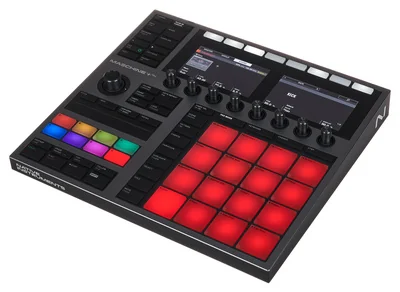
Native Instruments released MASCHINE in 2009, pairing a dedicated hardware pad controller with pattern-based sequencing software built around sample-based beatmaking. The company's own 2009 product page described it as a “groove production studio” that “combines the flexibility of computer-based music production with the tactile immediacy of a stand-alone groove box into one powerful creative tool.” Rather than a plug-in bolted onto an existing sequencer, MASCHINE was designed around loops, one-shots and sixteen touch-sensitive pads, aimed at building a beat-driven arrangement from samples rather than notating parts first.
What the documents show
Native Instruments' own feature-details page lists sixteen velocity-sensitive, illuminated pads with aftertouch, two backlit displays, eleven rotary knobs and forty-one buttons, and states the controller was built for “mouse-free operation of the MASCHINE software at every level, from initial spontaneous jams to complete arrangement of your finished tracks.” Both pages are Native Instruments' own marketing copy for the original hardware and software pairing; they describe design intent and hardware specification, not any independently measured claim about workflow speed or output quality.
What stays with the musician
MASCHINE's software organizes loops, one-shots and patterns for fast recombination, but it does not choose which sample fits a track's key or mood, when a pattern should break for a drop, or how a scene-based sketch should become a finished arrangement. A musician still auditions and edits the material the software surfaces, decides the sequence of scenes that becomes a song, and clears any sample used from a source that requires it, a step the manufacturer's pages do not address.
Judge it by listening
Native Instruments' own copy describes what the pads and displays let a musician do; it makes no claim about the musicality of any beat built with them. A reader evaluating a MASCHINE-built track can listen for whether the pattern-based structure varies across a song's sections or repeats too literally, and whether live pad performance layered over a sequenced pattern adds the human timing feel the product page's language of “immediacy” points toward. This is an editorial listening suggestion, not a documented test from the manufacturer.
- Does the arrangement vary enough across sections, or does it repeat the same locked pattern throughout?
- Where did a live pad performance, rather than a quantized pattern, shape the final groove?
- Are the samples used cleared for release, a decision the hardware and software do not make?
Sixteen years on, MASCHINE's pairing of a dedicated controller with sample-based sequencing reads as an early, hardware-anchored answer to a question later software-only tools would also ask: how to make loop-based arrangement feel like playing an instrument rather than programming one.
Sources & reading trail
Native Instruments' own 2009 product page describes Maschine as pairing a hardware controller with software for both computer-based production and stand-alone groove-box style workflow.
Source published: Not established · Retrieved: 16 September 2026
Describes the original MASCHINE controller's sixteen velocity-sensitive pads, two displays, and mouse-free workflow from initial jams to full arrangement.
Source published: Not established · Retrieved: 16 September 2026
Documentation, papers and the makers' own records establish the note; the judgment about what stays with the musician is Mix & Meaning editorial analysis. This retrospective draft does not imply the site published on the event date.