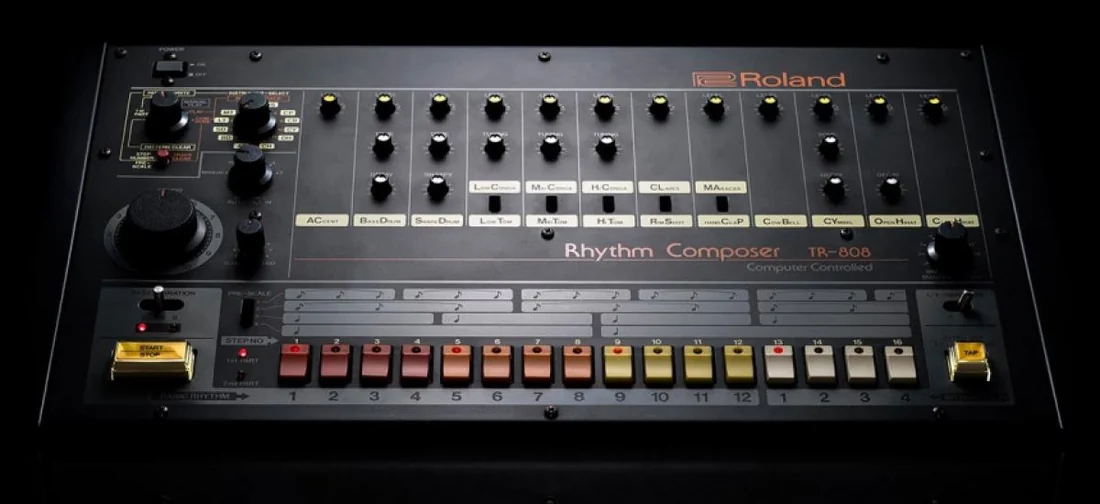
The tool moment
In 1980, Roland released the TR-808 Rhythm Composer. The company's own company history page describes it plainly: this programmable rhythm machine allowed musicians to program an entire song and achieved legendary status around the world. The 808 let a musician step-program a full arrangement of drum parts rather than tap out a fixed pattern from a preset bank. Roland's own retrospective on the TR-08 boutique reissue recalls that the 808 arrived in 1980 to an unsuspecting and somewhat bewildered public, since its sounds did not resemble a conventional drum kit.
What the documents show
Both Roland pages agree on a detail worth stating precisely: the TR-808 is an analog synthesizer, not a sampler. Its cowbell, hand claps, and sub-bass kick are generated by analog circuitry tuned to approximate acoustic drums, not recordings of them. The company's own description calls the sound purely analog, with tweakable parameters that studio engineers of the day found unfamiliar rather than instantly useful. Roland does not claim the 808 was an immediate hit, and the history page's legendary status language describes a reputation the machine built over the following decade, not one it had at launch.
What stays with the musician
Neither source claims the 808 arranged music by itself. The step sequencer only plays back what a musician programs into it: which drum voice sounds on which of sixteen steps, at what level, and in what pattern. Deciding whether a rim shot lands on an off-beat is still a rhythmic choice made by a person, not a factory pattern. The tuning knobs change the character of a sound, but a musician still decides which character serves the track. A drum machine that can be reprogrammed is not the same as one that decides for you.
Judge it by listening
A listener can hear the analog-versus-sample distinction directly: 808 voices lack the transient detail of a recorded drum hit, which is part of why the cowbell and hand-clap read as abstracted, and why the sub-bass kick behaves more like a tuned oscillator than a struck membrane. That thinness is not a flaw to correct; it is the timbre later hardware and software emulations try to reproduce. Judging an 808-descended preset against a recorded acoustic kit misses the point: the useful comparison is against the original circuit's own tuning range and decay behavior. This framing is editorial, not a claim from either cited source.
- Is the kick, snare, or cowbell in this session synthesized or sampled, and does that change what the tuning controls should do?
- Does the arrangement rely on the machine's step grid, or has it been nudged deliberately off-grid?
- When a plugin claims an '808 sound,' is it emulating the analog circuit or simply playing back a sample of one?
The TR-808 is a reminder that a tool's reputation and its launch reception are not the same thing. Roland's own materials date the machine to 1980 and describe programmability as its core feature; the sound that made it famous came later, from musicians finding uses for an analog circuit the market did not initially want.
Sources & reading trail
States the TR-808's 1980 release and that it let musicians program an entire song.
Source published: Not established · Retrieved: 16 September 2026
Roland's own retrospective describing the original TR-808's purely analog sound and 1980 arrival.
Source published: Not established · Retrieved: 16 September 2026
Documentation, papers and the makers' own records establish the note; the judgment about what stays with the musician is Mix & Meaning editorial analysis. This retrospective draft does not imply the site published on the event date.