
The tool moment
E-mu Systems released the SP-1200 in 1987; its own owner's manual is copyrighted that year and describes the machine as combining the most popular features of E-mu's first drum machine, the Drumulator, with the Emulator II's sampling capabilities. The manual states the SP-1200 uses 12-bit sound digitizing, which it says gives the drum sounds a crispness and dynamic range unattainable with the more common, inexpensive 8-bit digitizing technology of the time. That combination — sampled drum hits triggered from dedicated pads, sequenced like a drum machine — let a producer build a beat from real recordings, without needing a full sampling keyboard workstation.
What the documents show
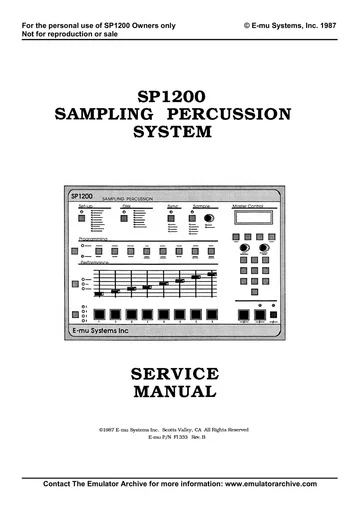
The manual is E-mu's own technical documentation, and its most specific, checkable claim is not about sound quality but about a hard limit: the sample period is fixed at a rate equal to 1 divided by 26.04 kilohertz, and elsewhere the manual states the SP-1200 has only one playback rate, confirmed separately by the 1987 service manual. That is a single, non-adjustable sample rate well below what contemporaneous 16-bit samplers offered, imposed by the hardware's converters rather than chosen as an artistic setting. E-mu's crispness claim is the manufacturer's own marketing language for the 12-bit format; it compares only to cheaper 8-bit machines of the era, not to modern converters.
What stays with the musician
A fixed sample rate does not choose which sounds get sampled through it, or how a producer arranges them into a beat. The manual's technical limit is exactly that — a limit — and the sourced material does not name which producers built a signature sound around it; that attribution belongs to accounts this note has no open documents to verify, so none is made here. What the manual does establish is that the constraint was involuntary: E-mu built the SP-1200 to the highest fidelity its converters and fixed clock allowed, and any producer using it since has been working with, not choosing, that ceiling.
Judge it by listening
A listener can identify the SP-1200's signature by ear against the manual's own numbers: a fixed 26.04kHz sample rate imposes an anti-aliasing filter response and a 12-bit noise floor that a modern high-resolution sample will not reproduce unless deliberately downsampled to match. Comparing a drum hit run through SP-1200-style resampling against the same hit at full modern resolution is a documented, specification-linked way to hear what the fixed rate removes, rather than describing the result only as gritty or warm. Whether that removed detail improves a track is a musical judgment, not a specification.
- Is a 'lo-fi' drum texture coming from a genuinely fixed sample-rate limitation, or from a plugin's adjustable emulation of one?
- What frequency content does downsampling actually remove from this specific drum hit?
- Is a hardware constraint being used deliberately, or is it simply the only option the machine ever offered?
E-mu's own manuals are unusually precise about the SP-1200's numbers, which makes the machine a clean case study: a fixed technical ceiling, imposed by 1987 hardware, that later became something producers sought out rather than a limitation they merely tolerated.
Sources & reading trail
E-mu's own manual states the 1987 copyright date, 12-bit sampling, and fixed 26.04kHz sample rate, plus the vendor's own claim about dynamic range versus 8-bit digitizing.
Source published: Not established · Retrieved: 16 September 2026
Confirms the 1987 date and technical specification of the SP-1200 hardware.
Source published: Not established · Retrieved: 16 September 2026
Documentation, papers and the makers' own records establish the note; the judgment about what stays with the musician is Mix & Meaning editorial analysis. This retrospective draft does not imply the site published on the event date.