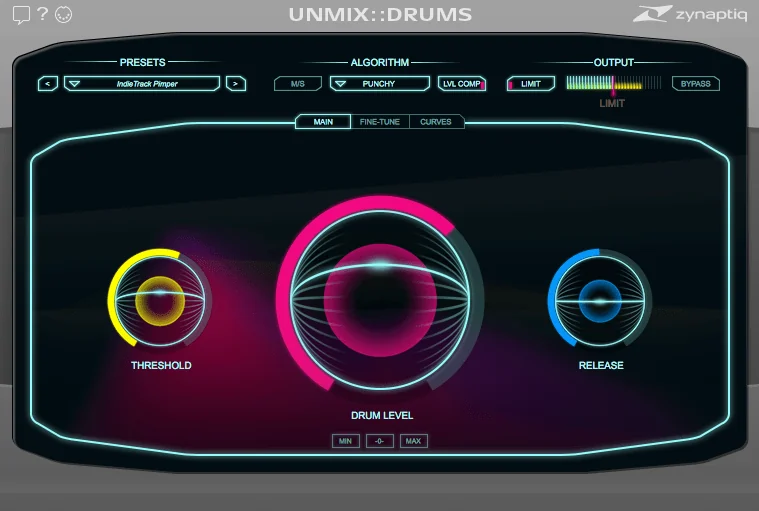
The tool moment
In 2015, Zynaptiq released UNMIX::DRUMS, a plug-in the company's own archived overview page calls "the world's first audio plugin that allows attenuating or boosting drums in mixed music, in real-time." Unlike a DJ-facing stem splitter, UNMIX::DRUMS shipped as a studio effect for Avid, Steinberg and Apple plug-in formats, confirmed on Zynaptiq's own specifications page, which lists AU, VST 2.4, RTAS and AAX Native support and a Mac OS X 10.6.8 minimum. It targeted mastering engineers, producers, mash-up artists and remixers working inside a DAW, not a live performance context.
What the documents show
Zynaptiq's overview describes the tool's core action as a single "after-the-fact fader for the drums," using source-separation technology to raise or lower the level of drums "relative to everything else" in a mix, from up to 18dB of boost down to "virtually complete removal." Critically, the page never claims the plugin isolates a kick from a snare or a hi-hat: it separates drums as one category from everything else as the other, plus a companion sub-bass resynthesizer. That is Zynaptiq's own description of the plugin's scope, not an independent test of separation accuracy, and it draws a boundary a reader should not read past.
What stays with the musician
Because UNMIX::DRUMS controls drums as a single relative level rather than exposing individual voices, an engineer still has to decide how much of the kit to pull forward or back, and at what point boosting starts to sound unnatural given the source material's own recording. The specifications page's pricing and iLok licensing details confirm this is bought as a mixing tool for a specific session decision, not a creative source of new, cleanly separated drum stems to build a new arrangement from.
Judge it by listening
Zynaptiq's pages describe two boost modes, "SMOOTH" and "PUNCHY," but publish no listening-test comparison between them. This is an editorial suggestion: run the same drum-heavy passage through both modes at a matched boost level and listen for how each handles reverb tails and low-frequency energy, since the overview notes both modes affect drum reverb differently. Also listen at the plugin's stated extremes, maximum attenuation and maximum boost, for the artifacts the "virtually complete removal" language already hints are possible rather than guaranteed.
- Does attenuating the drums to near-silence introduce audible artifacts on your specific mix?
- Which boost mode, SMOOTH or PUNCHY, better suits the genre and reverb character of your source?
- Is a single drums-versus-everything-else control enough, or does your mix need individual drum voices?
UNMIX::DRUMS is a narrower claim than a full stem splitter, and Zynaptiq's own documentation is careful to describe it that way; the engineering decision it leaves behind is how far to push a single fader once that boundary is understood.
Sources & reading trail
Zynaptiq's own overview describing UNMIX::DRUMS as the first plugin to boost or attenuate drums in mixed music using source-separation technology, without separating individual drum voices.
Source published: Not established · Retrieved: 16 September 2026
Confirms plug-in formats (AU, VST 2.4, RTAS, AAX Native), system requirements and pricing, establishing UNMIX::DRUMS as a DAW studio plug-in rather than a DJ or standalone application.
Source published: Not established · Retrieved: 16 September 2026
Documentation, papers and the makers' own records establish the note; the judgment about what stays with the musician is Mix & Meaning editorial analysis. This retrospective draft does not imply the site published on the event date.