The tool moment
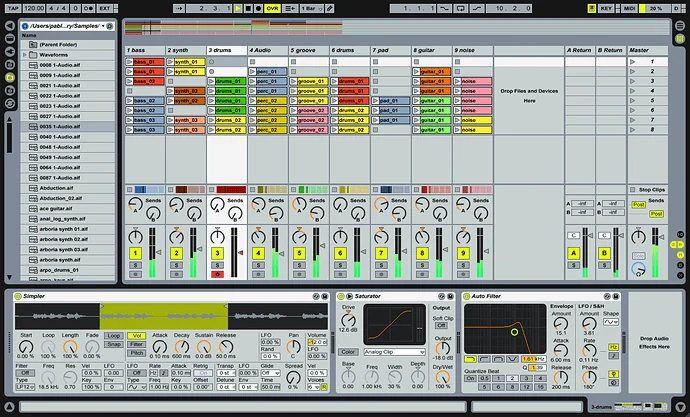
Ableton's own archived materials from early 2001 describe Live 1.0 as, in the company's words, the world's first audio-sequencer conceived for live music. A February 2001 product page explains that clips could be launched from the computer keyboard or via MIDI, with the resulting performance viewable and editable afterward as an arrangement. A company press release dated Berlin, 15 January 2001 names this clip-launching workspace session-view explicitly, distinct from the separate arranger-view used to turn a session into a finished piece. This is the direct ancestor of the Session View still in every current copy of Live.
What the documents show
Both documents are Ableton's own pre-launch promotional materials, not independent reporting, and their target ship dates moved: the January press release said Live would hit the retail shelves by October 2001, while the February product page narrowed that to the second quarter of 2001. Neither source in front of us states the exact date Live 1.0 actually shipped, only these company-announced windows, so a specific release day should not be asserted from them. A later Ableton press release, issued for Live 9 in 2013, retrospectively states the company released the first version of Live in 2001, corroborating the year without adding a day.
What stays with the musician
The January 2001 release is explicit that session-view and arranger-view are separate steps: the session's protocol can be examined and edited in the arranger-view, and that is how a session becomes a piece. Even in 2001, Ableton's own description treated real-time clip launching and the subsequent arrangement as distinct kinds of work. That same division persists into Live's much later AI-assisted stem-separation feature: pulling an isolated stem is not the same decision as deciding where it belongs in a finished arrangement, which is still the musician's call.
Judge it by listening
Neither 2001 document makes a testable sound-quality claim, only a design description, so there is no vendor listening test to check here. What a reader can evaluate editorially, using the same distinction Ableton itself drew in 2001, is workflow: does a session-view-descended tool still require the musician to build an arrangement afterward, by ear, or does it try to finalize that arrangement automatically on the tool's own terms?
- Is a described feature part of session-view clip launching, or part of the separate arrangement step Ableton itself distinguished in 2001?
- Is a company's announced ship date being treated as a confirmed release date, when the source only documents a target window?
- Does a modern AI feature built on top of Session View still leave the arrangement decision to the musician, as the original design did?
Live's session view began as a specific, documented answer to a specific problem: letting a musician play a set the way a DJ or performer would, rather than program it in advance. Every later feature built on top of that view, AI-assisted or not, still has to answer to the same split between launching a clip and arranging a piece.
Sources & reading trail
Ableton's own February 2001 product page describes Live as a clip-launching sequencer for live performance, with a targeted second-quarter 2001 ship date.
Source published: Not established · Retrieved: 16 September 2026
Ableton's own dated press release names Live's session-view clip pool and arranger-view, and states an October 2001 target ship date.
Source published: 15 January 2001 · Retrieved: 16 September 2026
Ableton's 2013 press release retrospectively states the company released the first version of Live in 2001, corroborating the year.
Source published: 5 March 2013 · Retrieved: 16 September 2026
Documentation, papers and the makers' own records establish the note; the judgment about what stays with the musician is Mix & Meaning editorial analysis. This retrospective draft does not imply the site published on the event date.