The tool moment
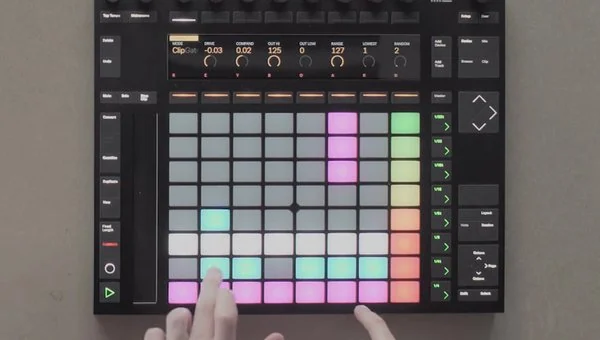
Push launched on 5 March 2013, the same day as Live 9, per Ableton's own press release, which describes it as designed by Ableton, built by Akai Professional, with 64 pressure- and velocity-sensitive multi-color pads and 11 touch-sensitive encoders. The release states the goal was to let a musician play and compose musical ideas without the need to look at or touch a computer. Push shipped bundled with a Live 9 Intro download license and worked with any edition of Live 9.
What the documents show
The press release is promotional copy from Ableton itself, so a phrase like an innovative workflow is the vendor's own framing; its physical specifications — pad count, dimensions, weight, connections — are objectively checkable facts a manufacturer states about its own hardware, distinct from a subjective performance claim. Ableton's separate, dated Live 9 release-notes archive independently corroborates that Push existed as a maintained control surface throughout the 9.x update cycle, and the same document distinguishes ongoing fixes for the original Push from a separate Push 2 hardware revision mentioned later in the log — useful for not attributing Push 2-only changes to the 2013 unit.
What stays with the musician
The press release's own description is that Push folds a keyboard's worth of notes onto its pads and lets a player improvise with song structure, but the same document is explicit that the destination for that work is still the computer: everything created with Push is laid out in Ableton Live on the computer, ready for fine-tuning, arrangement and export. The hardware changes the physical interface for triggering and arranging; deciding what to keep and how a jam becomes a finished arrangement remains work the musician does afterward.
Judge it by listening
Push is an input device, not an audio processor, so Ableton's own materials make no sound-quality claim to test. What a reader can check, by ear and hand together, is whether an idea built on Push's pads survives largely unedited once moved into Arrangement View, or whether it required so much subsequent fixing that the hands-on, no-computer-needed framing did not hold up in practice.
- Is a hardware spec, like pad count or dimensions, a checkable fact from the manufacturer, or a subjective workflow claim?
- Does a fix or feature mentioned in Ableton's changelog belong to the original 2013 Push or to the later Push 2?
- Once an idea is built on a hands-on controller, how much editing does it still need before it becomes a finished arrangement?
Push's launch paired a specific piece of hardware to a specific software release on a single documented date, and Ableton's own materials are careful to describe it as a controller for Live, not a replacement for the arrangement step that still happens on the computer afterward. That framing has held across a decade of Push hardware revisions.
Sources & reading trail
Ableton's own press release describes the original Push's design, its joint development with Akai Professional, its pad and encoder layout, and its bundling with Live 9.
Source published: 5 March 2013 · Retrieved: 16 September 2026
Ableton's own dated changelog documents ongoing fixes for Push through the Live 9.x cycle and distinguishes it from the later Push 2 hardware.
Source published: Not established · Retrieved: 16 September 2026
Documentation, papers and the makers' own records establish the note; the judgment about what stays with the musician is Mix & Meaning editorial analysis. This retrospective draft does not imply the site published on the event date.