The tool moment
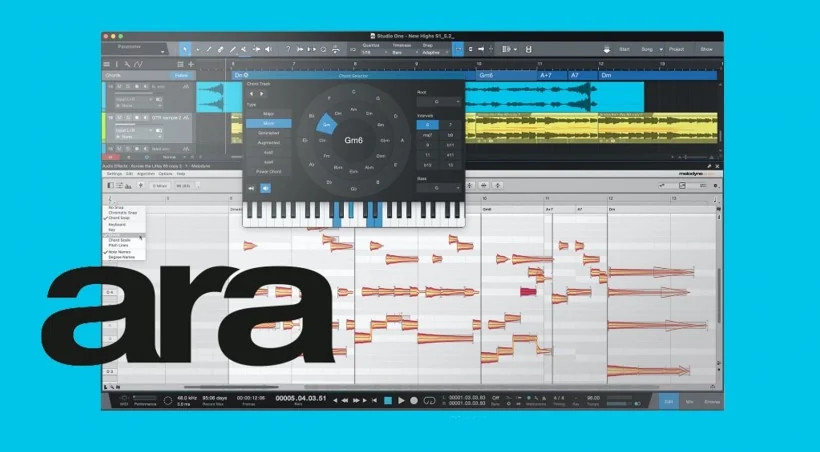
In a page Celemony published in 2011 explaining its new extension, the company describes working “together with Presonus” to develop ARA, Audio Random Access, so a plugin like Melodyne could get “for the first time musical access to the audio data” inside a host DAW, rather than only receiving audio “at the moment of playback” the way VST, AU and RTAS worked. The page states plainly where ARA first shipped: “Melodyne editor, assistant and essential from Version 1.3 onwards are equipped with ARA. The first DAW to implement ARA is Presonus Studio One Version 2.” With ARA active, a clip on a DAW track could be “opened directly in Melodyne” and would “follow automatically” when moved, copied, shortened or muted, without the separate file transfer Melodyne otherwise required.
What the documents show
The 2011 page is Celemony's own explanation of a standard it co-developed, not an independent audit, and it is explicit that ARA is “not a new plug-in interface designed to compete with the existing ones but simply an optional extension that has to be supported both by the DAW and by the plug-in” – adoption always depended on other manufacturers choosing to build it in. Celemony's current, living DAW-compatibility page, retrieved 16 September 2026, lists hosts it tests today: Pro Tools, Logic Pro, Cubase, Fender Studio Pro (the renamed PreSonus Studio One line), Ableton Live, Universal Audio's Luna Pro, Digital Performer, Nuendo, Samplitude, Sequoia, Mixcraft, Reaper and Cakewalk Sonar. FL Studio and Bitwig Studio do not appear, so every major DAW supports ARA is not a claim either document supports.
What stays with the musician
ARA changes how smoothly a pitch-and-time edit moves between plugin and timeline; it does not decide what that edit should be. Melodyne's automatic tempo and pitch detection still hand a musician the note-by-note choice of what to correct, what natural pitch drift to leave alone, and where a fixed vocal starts to sound stripped of character. Faster, transfer-free access to the audio changes the mechanics of editing, not the taste applied to it.
Judge it by listening
Neither Celemony document claims ARA itself changes audio quality, since it is a communication channel between plugin and host, not a processing algorithm. This is editorial guidance beyond the source: when comparing ARA-integrated editing against the older transfer-based workflow, listen for whether time-stretched or pitch-corrected passages keep the same character across both methods, since ARA's benefit is workflow speed and automatic sync, not a change in Melodyne's own algorithm.
- Does this DAW's ARA implementation actually appear on Celemony's current compatibility list, or is support assumed rather than confirmed?
- When Melodyne follows a clip move or tempo change automatically, does the resulting edit still get checked by ear before moving on?
- Would this pitch correction sound different done through the older transfer-based method?
ARA is a plumbing decision from 2011 that made Melodyne feel native inside a timeline rather than bolted on beside it; more than a decade later, Celemony's own list shows that plumbing is still not universal, worth checking before assuming a given DAW has it.
Sources & reading trail
Celemony's own 2011 page explaining ARA's purpose, joint development with PreSonus, and Studio One Version 2 as the first host DAW to implement it.
Source published: Not established · Retrieved: 16 September 2026
Celemony's current, living adopter list naming Pro Tools, Logic Pro, Cubase, Fender Studio Pro, Ableton Live, Universal Audio Luna Pro, Digital Performer, Nuendo, Samplitude, Sequoia, Mixcraft, Reaper and Cakewalk Sonar as ARA-compatible hosts it tests.
Source published: Not established · Retrieved: 16 September 2026
Documentation, papers and the makers' own records establish the note; the judgment about what stays with the musician is Mix & Meaning editorial analysis. This retrospective draft does not imply the site published on the event date.