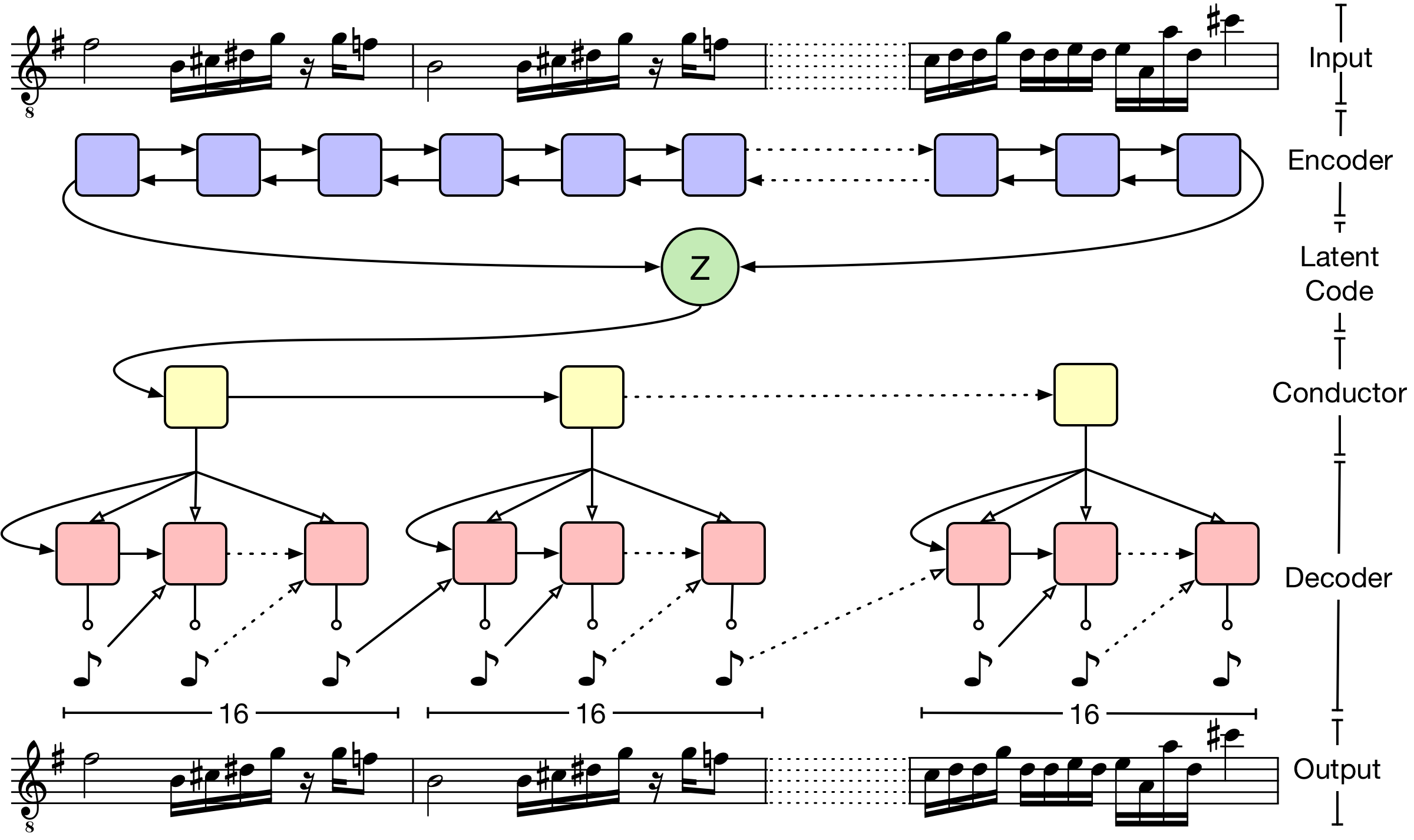
MusicVAE’s original architecture figure connects a longer musical sequence to a hierarchy of shorter phrases.
Magenta / Google · Source ↗Original 2018 research diagram, not a fabricated product screen.A model for the middle of the process
Magenta introduced MusicVAE on March 15, 2018 as a variational autoencoder for musical scores. The proposal was unusually legible to musicians: explore and blend symbolic sequences before committing them to the page or session. Later that spring, Magenta showed multitrack MusicVAE with General MIDI measures and optional chords, and its JavaScript release put model demonstrations in the browser. These were research and creative-tool experiments, not a claim that a complete song could be made by sliding a control.
Why interpolation was the interesting control
Writers already know the problem MusicVAE addresses. One eight-bar idea has a useful rhythm; another has a convincing contour; neither earns a second section. Interpolation offers in-between candidates. Its contribution is not authority. It is a fast way of finding a question worth answering with human ears and hands: should the turn happen earlier, should the contour climb less, does the bass answer the melody or simply double it?
That makes the MIDI representation crucial. Symbolic output exposes pitch, duration, velocity and track role for revision. A producer can move one note against the kick, change a chord inversion, replace the whole accompaniment, or use only a rhythmic gesture. The modeled sequence is therefore closer to a sketchbook page than a master. Its limitations are equally instructive: General MIDI timbres, quantized grids and short formal windows can make a phrase feel generic before any harmonic decision has been properly heard.
Use the result as counterpoint to your first instinct
A useful session method is to enter a deliberately modest seed: four bars that state the rhythmic problem. Generate or interpolate several alternatives, mute the model’s original sound, and audition only their note relationships in the project’s own instrument palette. Keep one event at most from a candidate unless its entire phrase has a clear job. Then replay it with a performer or redraw it with the song’s real articulation. This prevents the output’s neatness from becoming the arrangement.
The historical distinction matters. The sources document Magenta’s 2018 model, demos and representations. They do not establish present-day hosting, browser support, feature parity, or a commercial product route.
Listen without the visual grid. Export a simple piano sound and dim the screen. If the candidate’s identity vanishes without colored notes and model lore, it has probably not yet become a musical decision. If it still creates tension, release, or a useful interruption, bring it back to the session and give it a human articulation. The palette becomes valuable when it helps a writer hear an option they can own.
Save the rejected versions too; they document which rhythmic or harmonic path the arrangement deliberately did not take.
Name the musical problem before asking a latent space to make it prettier.
The original record
- MusicVAE: Creating a palette for musical scores with machine learning · 2018-03-15
initial MusicVAE announcement and symbolic-score focus - Multitrack MusicVAE: Interactively Exploring Musical Styles · 2018-06-05
multitrack MIDI and chord-conditioning demonstration
Original source review: 16 September 2026; individual records retain later checks. The workflow analysis is editorial interpretation; it does not report an in-house product test.