Start at the point of choice
A useful way to think about creative tools is to notice where they place the next decision. A new accompaniment can move the question from “what notes could go here?” to “does this section need another part at all?” That change is small enough to miss and large enough to shape a song.
Our underlying production research favors a process led by a person: a brief, a sketch, deliberate revision, and a final listening check. This essay follows one part of that process—the arrangement—without treating speed as a measure of musical value.
A historical example
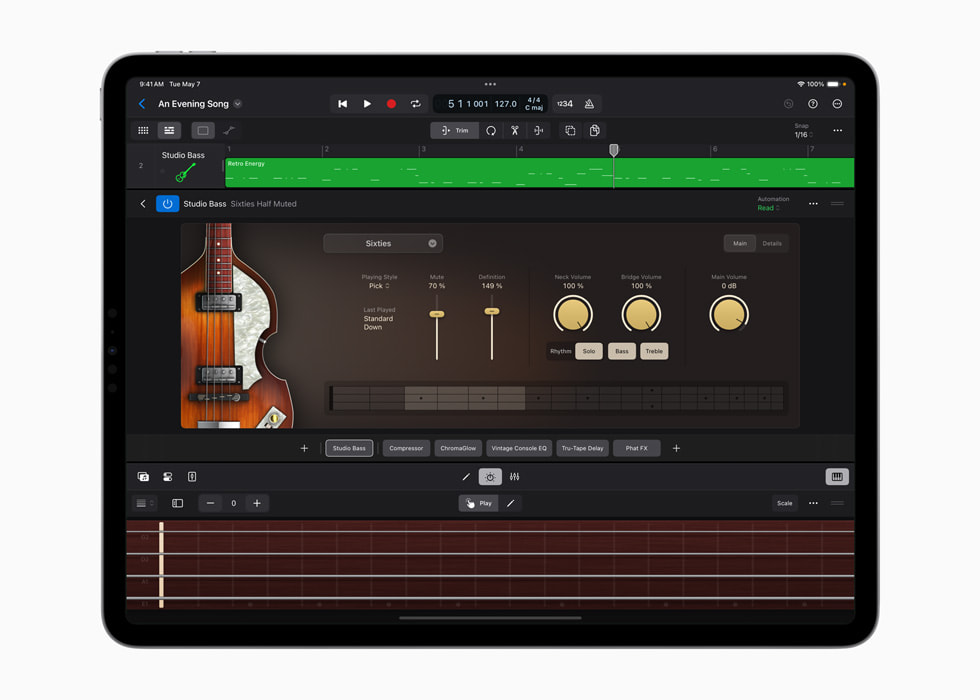
Apple’s May 2024 Logic Pro announcement described Session Players for bass and keyboard alongside its drummer. The announcement presented controls for shaping accompaniment. That is a description of available assistance at that moment, not evidence that the result suits any particular song.
The interesting connection is between a generated suggestion and the decisions surrounding it. A part can be plausible on its own and distracting in the section where it lands. “The tool produced something usable” and “the song needed this” are different judgments.
A three-pass arrangement exercise
Use a short passage from a project you control. Before adding anything, write one sentence about its dramatic job: perhaps the verse should feel unsettled, or the chorus should open outward. This gives you a reference more specific than “make it better.”
- Listen for the center. Identify the element you want the listener to follow. Describe how the other parts support it or compete with it.
- Try a subtraction. Mute one supporting part for a section. Notice whether the center becomes clearer or the passage loses something essential.
- Make one revision. Change an entrance, register, rhythm, or ending. Compare against the version you saved before the edit.
If assistive software offers a fresh accompaniment, bring it through the same exercise. The question is the part’s relationship to the song. A convincing demonstration in isolation does not settle that relationship.
Leave a trail of decisions
Save a version at each meaningful turn. Write the reason for an edit in ordinary language: “the bass leaves room for the pickup,” or “the extra chord makes the arrival feel early.” These are illustrative notes, not observations from a named recording.
A decision trail makes a revision discussable. A collaborator can disagree with the intended effect, suggest another way to achieve it, or hear something you missed. That is more useful than arguing about which version is simply “more professional.”
What the tool cannot settle for you
Our reading is that assistive systems make the location of taste more visible. Suggestions arrive; selection, timing, and restraint give them a place. Keep listening beyond the moment of generation. The edit that matters might be the part you decide to leave out.
Sources & reading trail
- Apple: Logic Pro’s May 2024 feature announcement — dated, primary context for bass and keyboard Session Players.
- Ableton: Stem Separation FAQ — related reading for studying parts in an existing authorized mix.
This is an editorial essay with an original practice exercise. The Apple feature description is historical; no current product recommendation or measured creative outcome is asserted.