The song, taken apart
A voice in a finished mix has neighbors. There is a drum beneath it, a chord around it, a room or an effect trailing behind it. Stem separation offers a way to hear those relationships by loosening them. It also introduces a question: are we hearing the original part, or an estimate of where one part ends and another begins?
The distinction matters to listening as much as it does to production. Treat a separated file as a new perspective on a recording. Resist the temptation to treat it as a recovered studio truth.
The technical connection
Ableton’s separation documentation describes dividing audio into vocals, drums, bass, and other material. It also explains that source quality and the relationship between the audio and the separation model affect the result. A category name on a file is not a guarantee of clean isolation.
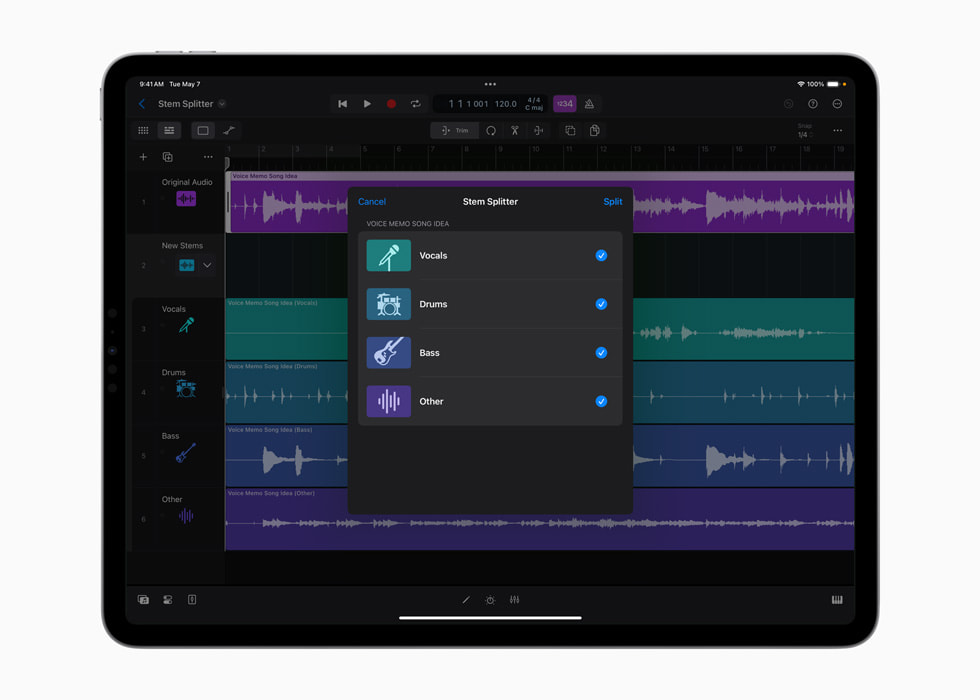
In its May 2024 Logic Pro announcement, Apple presented Stem Splitter as a way to separate a mixed recording into parts for further work. Read that as the vendor’s account of a feature, rather than an independent judgment of the sound.
Listen at the edges
For this exercise, use your own recording or material you have permission to process. Choose a short section you know well. First listen to the complete mix and describe what holds your attention. Avoid instrument names for a moment: is it a pulse, a breath, a sudden opening of space?
Now listen to one separated part. Pay attention to the beginning and end of each phrase. Does a consonant carry a trace of another sound? Does a sustained note change character as the backing enters? These are prompts for your ears, not results from a test we have conducted.
Return to the full mix. Ask whether the detail that sounded strange alone is perceptible in context. The useful judgment may depend on the job: a private arrangement study, a rehearsal aid, and an exposed solo passage demand different things.
“In isolation I noticed ____. In the full mix I heard ____. For the use I have in mind, that difference matters because ____.”
The space around a sound
Our interpretation is that separation can make arrangement feel less abstract. When a part disappears, you can attend to what had been sharing its space. That does not tell you what the original musician intended. It gives you a question to bring back to the complete work.
Keep the original file and label the transformation. Separate technical possibility from permission: being able to extract a part does not, on its own, establish that you can release it. This exercise concerns listening and work on authorized material, not a clearance decision.
Sources & reading trail
- Ableton: Stem Separation FAQ — vendor documentation for categories, source-dependent quality, and processing.
- Apple: Logic Pro’s May 2024 feature announcement — historical product context for Stem Splitter.
The listening exercise and interpretation are editorial. No comparative audio test, artist intention, or right to reuse a commercial recording is claimed.