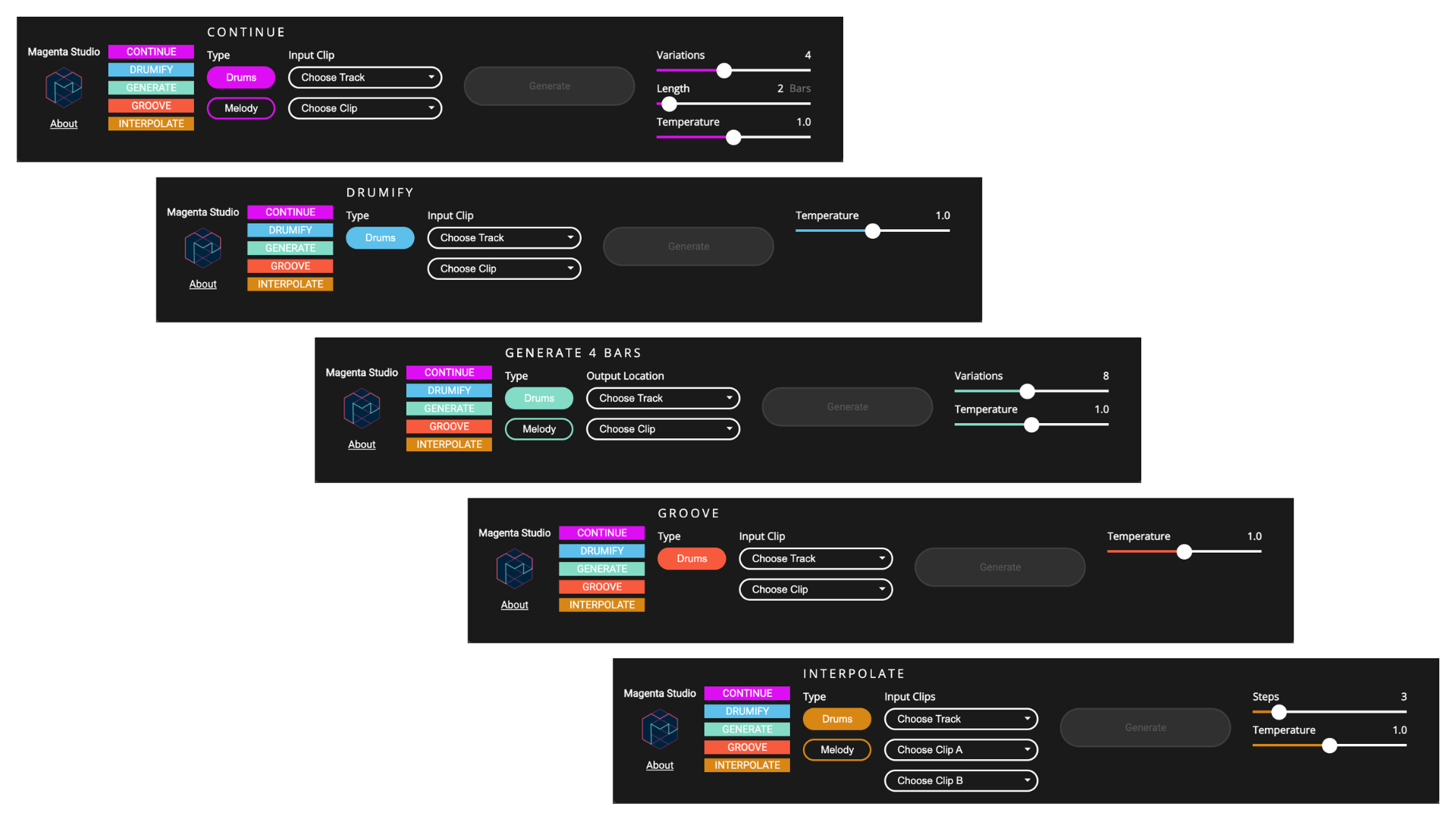
Magenta Studio’s own interface overview makes five different musical operations visible.
Magenta / Google · Source ↗The page’s current illustration was retrieved in September 2026; no historical screenshot date is claimed.Start with the action, not the badge
“Made with AI” compresses several unlike actions into one vague label. A noise reducer estimates unwanted sound. A stem separator estimates components inside a mix. A session player proposes a performance. A song generator can supply melody, harmony, words, voice and recording at once. Those differences affect musical control, disclosure, clearance and the evidence worth keeping.
Describe the task in verbs: separated, extended, transformed, suggested, generated, tuned, mastered. Then name the source material and the person who chose the result. This makes a session easier to understand months later and gives a distributor or collaborator something more useful than a binary label.
A contribution map
For each important element, record who or what supplied it. A human may write the lyric, sing the guide, choose a generated harmony, replace its bass, edit the form and mix the result. The final recording is therefore a chain of contributions rather than a single yes-or-no state.
- Source: what entered the system and who controlled it.
- Operation: what the tool was asked to do.
- Selection: what a person accepted, rejected or combined.
- Revision: what was replayed, rewritten or edited.
- Delivery: what version was released and under which policy.
Why the distinction matters
Contract permission, copyrightability and platform acceptance are separate questions. A vendor can allow commercial use without promising that an output receives copyright protection. A platform can accept assistive processing while restricting synthetic impersonation or bulk uploads. Clear language prevents one answer from being stretched into another.
“I supplied ____. The system ____. I selected ____. I changed ____. The released version contains ____.”
What this guide cannot decide
Labels do not settle authorship or infringement. Those decisions depend on facts, contracts and jurisdiction. Use this vocabulary to expose the facts that a lawyer, client, platform or collaborator would need—not to manufacture certainty.
Sources & reading trail
- U.S. Copyright Office: Copyright and Artificial Intelligence — primary documentation or research used for the bounded claims above.
- YouTube: altered or synthetic content disclosure — primary documentation or research used for the bounded claims above.
Reviewed for this local compilation on 15 September 2026. Product terms and platform policies can change; recheck them for a release. This article is editorial guidance, not legal advice or a claim of independent product testing.