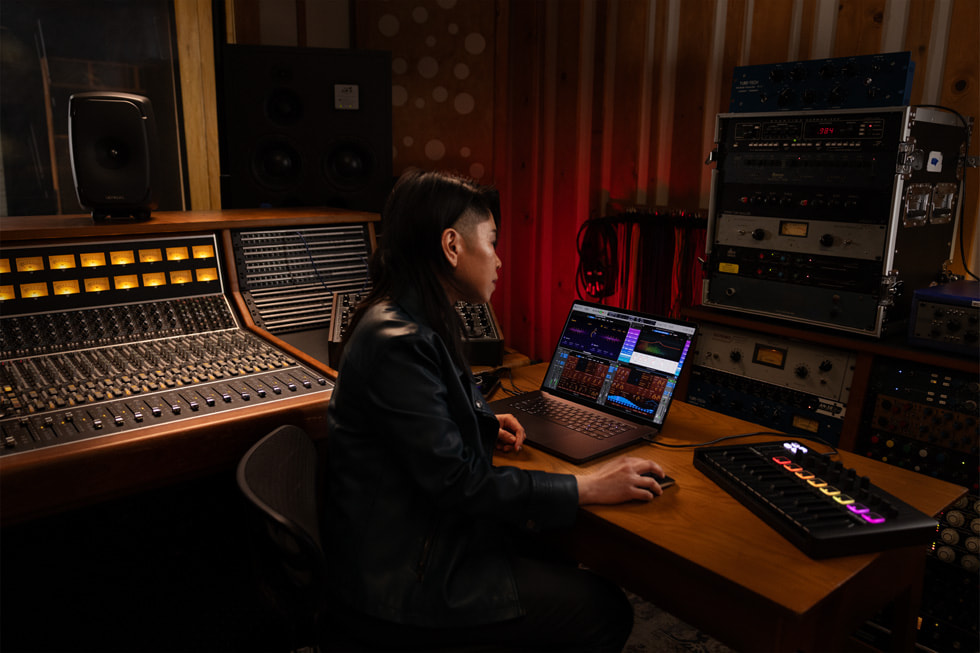
A recording-studio photograph from Apple’s May 2024 Logic Pro announcement.
Apple · Source ↗Contextual product photography; no interview, identity or endorsement is inferred.A prompt is not yet an intention
Genre words can produce a recognizable surface while leaving the musical purpose unresolved. Before opening a generator, write a brief that another musician could act on: the scene or feeling, the duration, the energy curve, the role of the music, the sounds to avoid and the moment that must remain open for a voice or picture.
This brief becomes the control version. It lets you compare outputs against a stable intention instead of rewriting the goal around whichever result arrives first.
Use constraints the ear can hear
“Warm and cinematic” is hard to audit. “Begin with a narrow texture, introduce the pulse after eight bars, reserve the brightest register for the final third” is more useful. Include form, density, register, rhythmic behavior and negative space. Avoid requesting a living artist’s identity; describe musical properties you can discuss and alter.
Keep exploration cheap
- Generate short sketches for direction, not finished songs.
- Tag each take with the prompt, settings and account plan.
- Listen once for form and once for material.
- Choose one reason to continue and one reason to stop.
- Move the promising idea into an editable session early.
The point is to reduce attachment to polish. A convincing vocal and mastered surface can hide a weak section change or a harmony that has nowhere to go.
Translate the sketch into decisions
When a sketch survives, name what you are keeping: a contour, a contrast, a tempo relationship, a texture. Reperform or rebuild what matters when practical. Human authorship is not measured by the number of mouse clicks; the useful question is whether the released work contains deliberate, traceable musical choices.
Purpose / listener / duration / energy curve / fixed elements / open elements / forbidden references / success test.
Sources & reading trail
- Google DeepMind: Lyria model page — primary documentation or research used for the bounded claims above.
- Stable Audio 3 announcement — primary documentation or research used for the bounded claims above.
Reviewed for this local compilation on 15 September 2026. Product terms and platform policies can change; recheck them for a release. This article is editorial guidance, not legal advice or a claim of independent product testing.