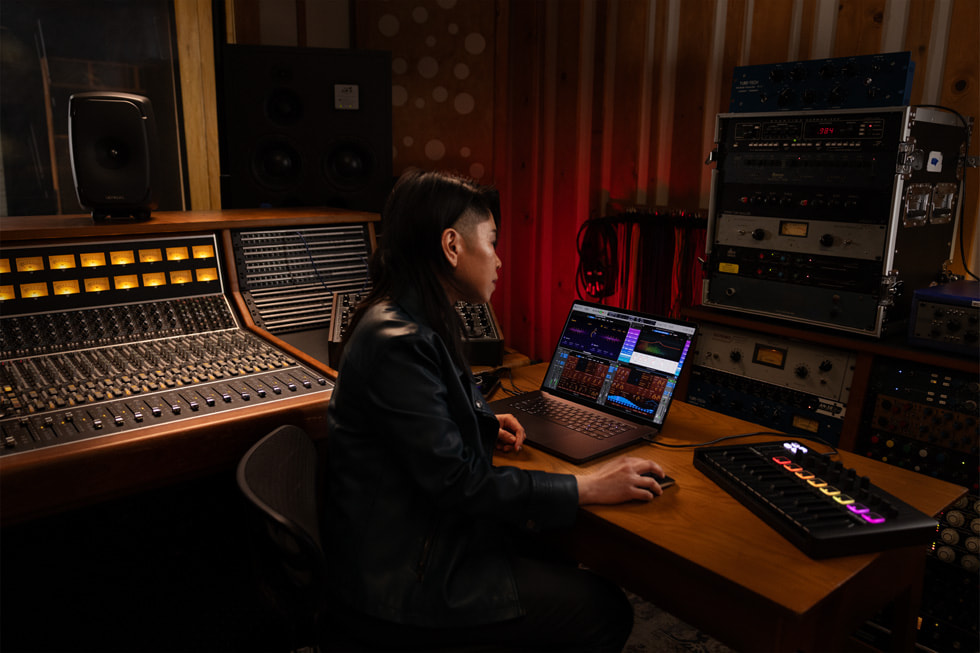
A recording-studio photograph from Apple’s May 2024 Logic Pro announcement.
Apple · Source ↗Contextual product photography; no interview, identity or endorsement is inferred.1. Write the musical brief
State purpose, form, constraints and what success sounds like. Name the human decisions that must remain central.
2. Clear the inputs
Confirm ownership or permission for audio, lyrics, voice, MIDI and reference material. Record whether the provider may retain or train on uploads.
3. Explore in a sandbox
Generate or transform short material. Keep prompts, settings, versions and plan evidence. Reject quickly when the result misses the brief.
4. Select for a reason
Write why a fragment survives: contour, texture, contrast, rhythm or structural idea. Do not confuse finish with fit.
5. Arrange and perform
Move material into an editable session. Rewrite form, replay important parts, create transitions and let musicians respond to one another.
6. Mix through comparison
Keep references and unprocessed lanes. Test automation or mastering as proposals, level-match comparisons and preserve dynamics that carry the song.
7. Build the evidence pack
Connect final assets to permissions, tool records, human edits and disclosure. Mark unknowns and obtain advice where stakes justify it.
8. Deliver to the actual destination
Check current policy, export the approved master, submit accurate metadata and retain the delivery ID. The loop ends when the released object and its record agree.
Human brief → cleared inputs → bounded assistance → human selection and arrangement → provenance → destination-specific delivery.
Sources & reading trail
- U.S. Copyright Office AI hub — primary documentation or research used for the bounded claims above.
- Fairly Trained — primary documentation or research used for the bounded claims above.
Reviewed for this local compilation on 15 September 2026. Product terms and platform policies can change; recheck them for a release. This article is editorial guidance, not legal advice or a claim of independent product testing.