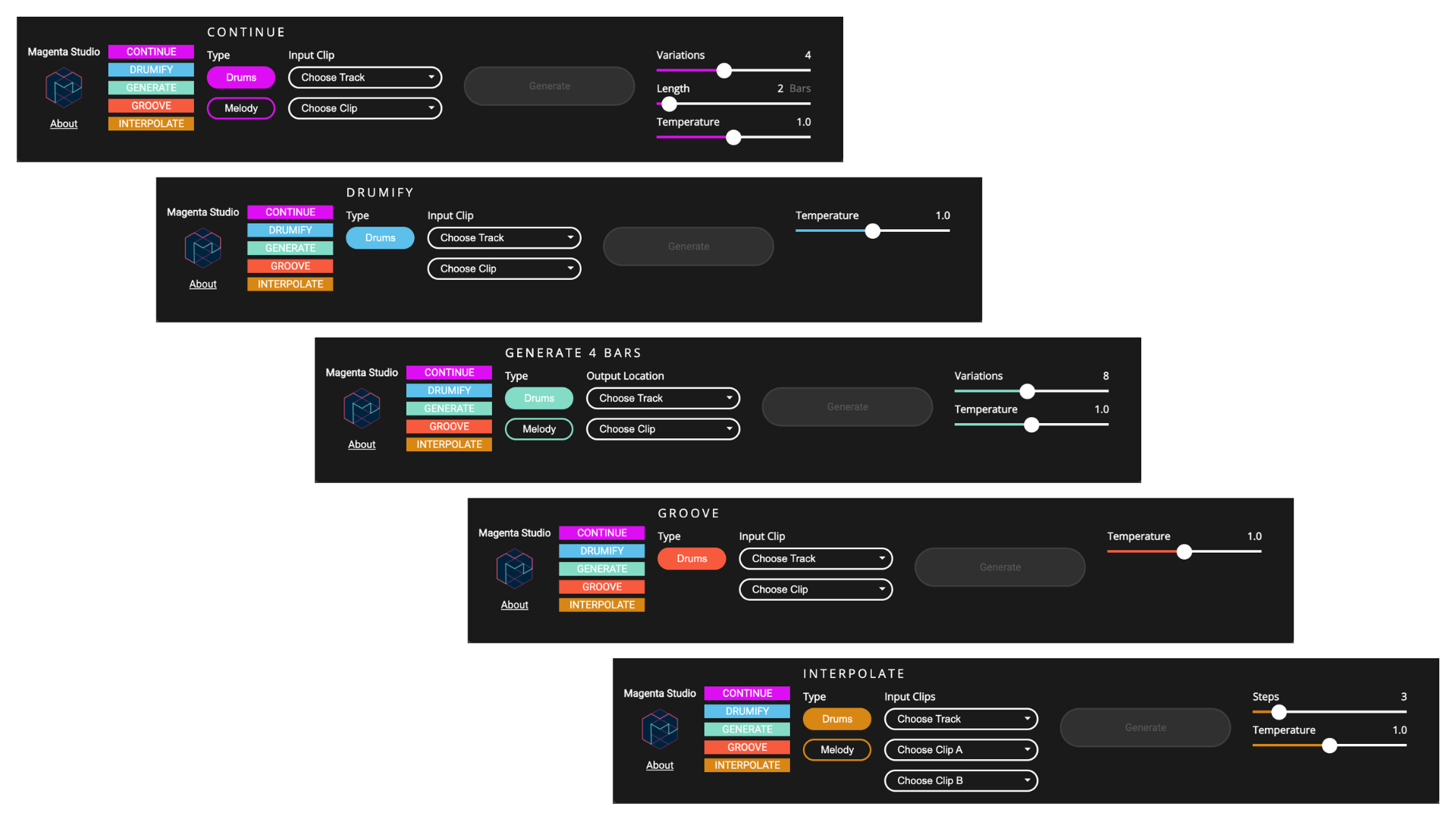
Magenta Studio’s own interface overview makes five different musical operations visible.
Magenta / Google · Source ↗The page’s current illustration was retrieved in September 2026; no historical screenshot date is claimed.Define the decision first
A useful audition answers a purchase or workflow question. Can this tool make editable sketches for a songwriter? Can it hold a thirty-second structure for picture? Can it export material a producer can actually reshape? “Which sounds best?” is too broad and invites the loudest, glossiest output to win.
Use three briefs
Prepare one easy brief in the tool’s apparent strength, one brief close to your real work and one stress brief with an awkward transition or sparse arrangement. Keep words and inputs fixed where the interfaces permit it. Record when a product prevents an exact repeat, because reproducibility is itself part of the result.
Score the working properties
- Instruction fit: did the form and role match the brief?
- Continuity: do sections feel causally connected?
- Editability: are stems, MIDI, sections or extensions usable?
- Failure: what artifacts, clichés or unstable details appear?
- Traceability: can you retain prompt, version, plan and license?
Listen level-matched when possible, and do not call an uncontrolled desk comparison a scientific listening test. State the files, dates, settings and limits.
Read the contract alongside the audio
An attractive take is not a release plan. Capture the terms and help pages that applied to the account and download. Check input permissions, commercial-use scope, output restrictions, plan changes, attribution and whether a later upgrade changes an older generation. If the answer is unclear, mark it unclear.
End with a workflow verdict
A verdict should name the user, task and boundary: “useful for short direction sketches, but export limits make it a poor handoff format.” That remains valuable after rankings and feature lists have gone stale.
Sources & reading trail
- Suno terms — primary documentation or research used for the bounded claims above.
- Udio help center — primary documentation or research used for the bounded claims above.
- Google Gemini API music generation docs — primary documentation or research used for the bounded claims above.
Reviewed for this local compilation on 15 September 2026. Product terms and platform policies can change; recheck them for a release. This article is editorial guidance, not legal advice or a claim of independent product testing.