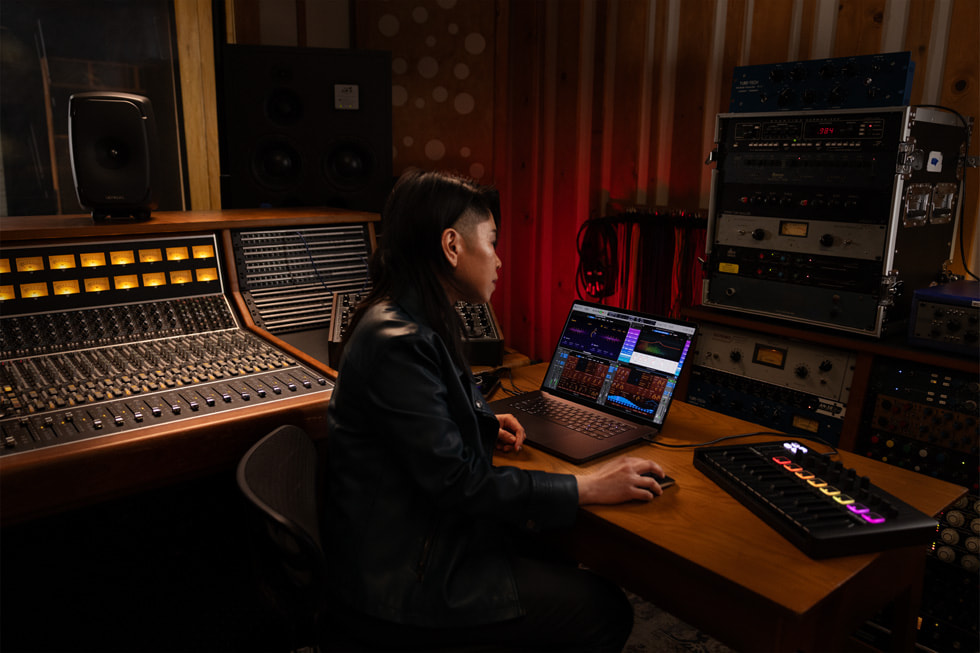
A recording-studio photograph from Apple’s May 2024 Logic Pro announcement.
Apple · Source ↗Contextual product photography; no interview, identity or endorsement is inferred.A generated passage can sound convincing until the instant it enters the song. That instant exposes a different room tone, a waveform discontinuity, a borrowed reverb tail, a change in stereo width, or a transient that lands just ahead of the beat. The seam is a small arrangement problem. Solve it in context, at low and normal monitoring levels, before adding more processing.
Find the musical handoff
Do not cut where the waveform is visually quiet by default. Find a handoff that has a musical reason: the end of a sung word, the release of a chord, the breath before a fill. Loop one bar before and one bar after it. If the passage enters on a pickup, give the pickup its own edit rather than forcing it onto a downbeat.
Repair clicks and tails separately
A click may need a short fade, while a mismatched ambience may need a longer overlap or an added room tail. Crossfades smooth two adjoining regions, but they cannot make unlike ambience identical. Apple documents both manual and automatic crossfades, including equal-power crossfades for adjacent regions. Test a few lengths; a longer fade can blur a consonant or kick transient that a very short fade preserves.
Check phase and width at the join
Soloing is useful for locating a problem, but judge the seam in the full mix. Flip to mono briefly and bypass any widening treatment on the generated section. If the entry loses body or the center image shifts, reduce width, choose a less-correlated layer, or begin the generated ambience after the dry attack. Do not “fix” a phase issue by simply making everything mono; identify which component contributes something worth keeping.
Worked example: an eight-bar replacement
Replace bars 5–8 of a generated pad because bar 5 contains a useful lift. Copy 500 ms of the preceding pad into an overlap, lower the incoming region until its chord speaks, and apply a short equal-power crossfade. The new pad has a longer reverb tail, so automate its send down during bar 8 and let the song’s existing return carry the final decay. In mono, the entry thins: narrow only the generated layer, not the whole pad bus.
Limitations
No crossfade repairs a mismatched chord, a different performance energy, or an unauthorized source. Sometimes the cleanest edit is to use the fragment as a transition layer and replay the main part. Preserve the unedited version and note renders or plugins used, especially before collaboration. Next, rebuild a weak transition when the section itself fails, and check stereo in mono before signing off.
Sources & working limits
- Apple: create fades on audio regions
Manual fades and equal-power crossfades are available. - Apple: automatic crossfades
Automatic crossfades can smooth overlapping regions. - Apple: MultiMeter correlation meter
Negative correlation can cause cancellation in mono.
Sources checked 2026-09-19. Product instructions describe the documented version; controls and availability may change. Session examples are illustrative, not measurements or listening-test results.