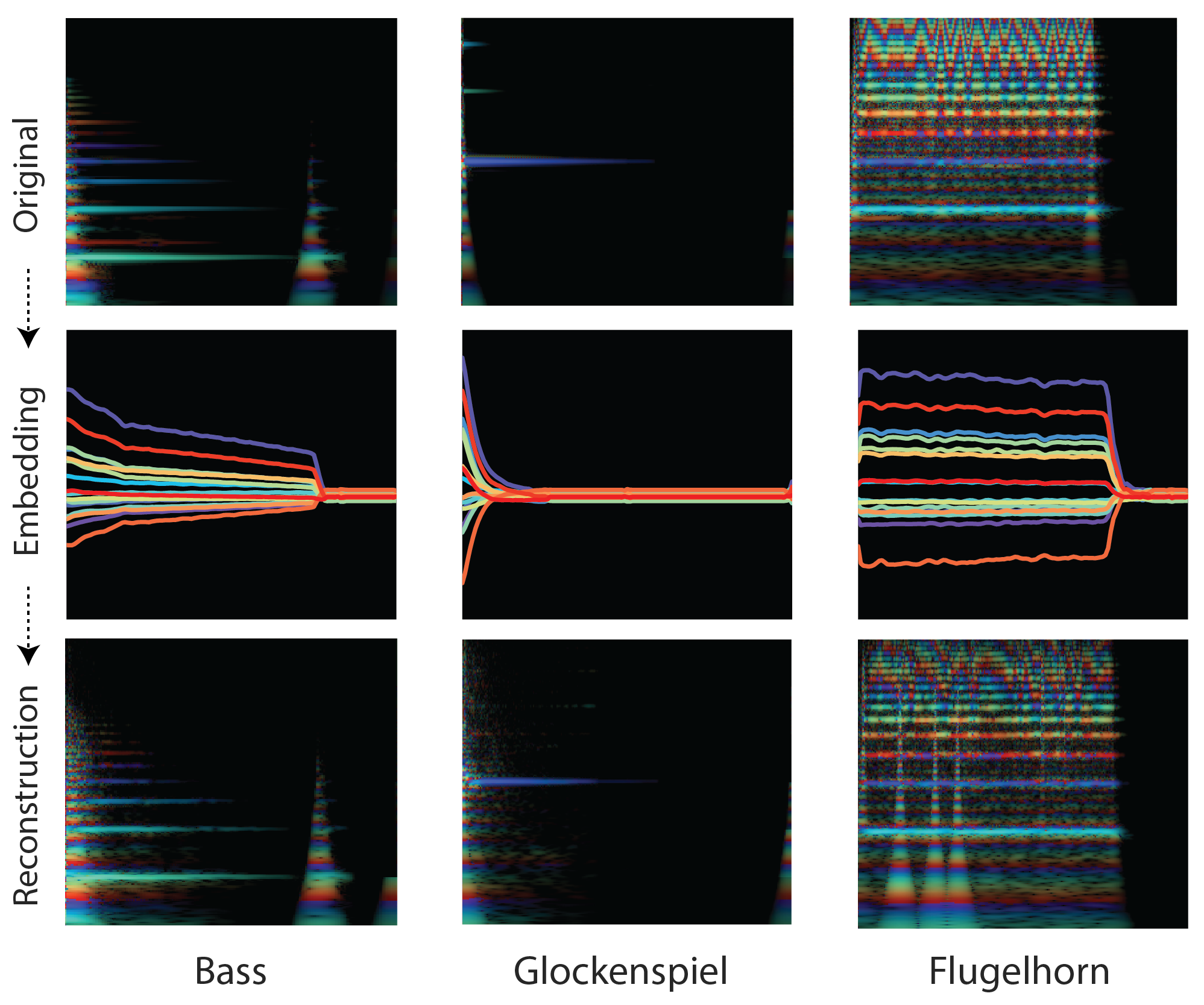
The original NSynth figure compares three instrument sounds with their embeddings and reconstructions.
Magenta / Google · Source ↗Research figure from 2017, not a commercial interface or a Mix & Meaning benchmark.What arrived
On April 6, 2017, Magenta introduced NSynth: a neural approach to synthesizing individual instrument notes. Its public record matters because it framed the task narrowly. Rather than claim to write a record, NSynth learned a representation of note-level sound and made that representation available for exploration. Magenta also released a dataset, code and trained weights. In May, it followed with a playable browser experiment and a Max for Live device that let players interpolate between paired instruments.
The musical change was in the audition
For a producer, the useful idea was not that a network could name an instrument. It was that timbre could be navigated between familiar endpoints. A patch built by moving from a mallet-like attack toward a reed-like sustain asks a concrete arranging question: which contour should carry the phrase? That is different from browsing a preset list by category. The ear can judge whether the blend gives a bass line enough front edge, leaves room for a vocal, or makes a chord voicing blur.
That promise has a hard boundary. A single-note dataset does not supply the interaction of players in a room, the voicing of a part, or the phrase-level change that makes an arrangement breathe. A neural sound may be striking in isolation and still be unusable once cymbals, consonants and low-end movement arrive. Treat it as raw orchestration material. Print a short pass, place it against the intended part, and decide whether to replay, layer or abandon it.
A practical retrospective
NSynth’s most durable production lesson is to make exploration reversible. Save the two source instruments, the interpolation position, MIDI and a dry render. Then write one sentence about why the sound survives: “its transient makes the offbeats readable,” not “it sounds futuristic.” If the part matters, make the performance earn its place through dynamics, register and timing. That turns a remarkable sound-design method into accountable musical work.
Historical capability is the point here: Magenta described a research release and playable experiments in 2017. This record does not infer current access, supported software, licensing, or product status from that announcement.
There is a compositional discipline hidden in that limitation. Do not ask an unusual patch to rescue an ordinary part. First play the figure on a plain sound, decide its register and rhythmic duty, then introduce the hybrid timbre only where it clarifies the form. Automate the blend as an arrangement event: perhaps it opens during a turnaround and narrows again when the vocal returns. The best use of a strange instrument is often contrast, not permanent novelty.
In the final mix, compare that event at low level as well as loud: a timbral trick must still clarify the phrase when the novelty disappears.
Does the interpolation change the role of the part, or merely its surface?
The original record
- NSynth: Neural Audio Synthesis · 2017-04-06
NSynth announcement, release materials and stated purpose - Making a Neural Synthesizer Instrument · 2017-05-18
playable browser and Max for Live instruments
Original source review: 16 September 2026; individual records retain later checks. The workflow analysis is editorial interpretation; it does not report an in-house product test.