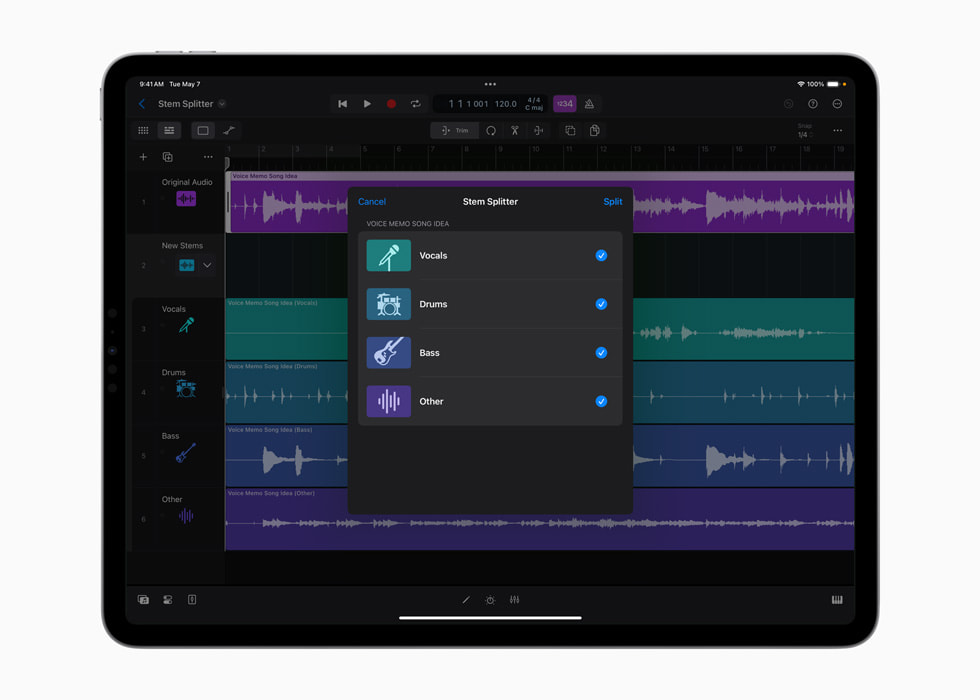
Apple’s May 2024 Stem Splitter interface shows the extraction choices beside the audio session.
Apple · Source ↗Historical interface; later versions can differ.A bounced “wet stem” can be either a helpful commitment or an opaque problem. The difference is whether the recipient can tell what the file contains, where it starts, which effects are shared, and whether its tail is intentional. Print effects when the sound is part of the arrangement, but export enough options that a mixer or collaborator can make an informed change.
Separate source, insert, and send decisions
A dry vocal with a distortion insert is not the same deliverable as a vocal sent to a shared reverb. Sends split signal into parallel aux paths; the wet return may contain contributions from several tracks. Name the dependency: “lead-vocal-dry,” “lead-vocal-insert-printed,” and “plate-return-shared.” Do not label a full mix bus contribution as a track stem.
Make a compact export set
For a critical part, provide dry, printed, and a wet-only return where the workflow permits. Include the same start time and sample rate for every file, a short text note on bus dependencies, and tails. Logic’s track export documentation offers options to bypass effect plugins, include volume/pan automation, and include audio tails. Those choices demonstrate why “exported” alone is not enough description.
Protect tails and automation
Set the export range so delayed repeats and reverb decay can finish. If a tail is only attractive because it overlaps the next section, include the adjoining bar or provide a reference bounce. Decide deliberately whether volume and pan automation should be performed. A dry editorial asset may need no performed automation; a creative printed version often does.
Worked example: generated texture on a shared shimmer bus
A texture is sent to a shimmer reverb shared with a guitar. Export the texture dry, the texture with its insert processing, and the shimmer return as a separate file. The return begins at the same session start even though it is silent for eight bars. Add a note: “Shimmer return also contains guitar in bars 17–24.” A collaborator can now retain the intended tail, remove the texture, or rebuild the balance without guessing.
Limitations
Files cannot substitute for plugin versions, routing screenshots, automation data, or a working session. Some effects are nondeterministic or depend on sidechains and external hardware; document those rather than claiming reproducibility. Printing also does not clear rights in a generated source. Before sending, use vocal-space listening and mono checks on the printed result.
Sources & working limits
- Apple: export tracks as audio files
Track export supports bypassing plugins, audio tails, and automation choices. - Apple: route audio via send effects
Send effects use parallel aux routing and can be shared. - Steinberg: Cubase Operation Manual
Rendering can include effect tails and pre/post crossfades.
Sources checked 2026-09-19. Product instructions describe the documented version; controls and availability may change. Session examples are illustrative, not measurements or listening-test results.